

Can You Glue Wall Panels Directly to Drywall?
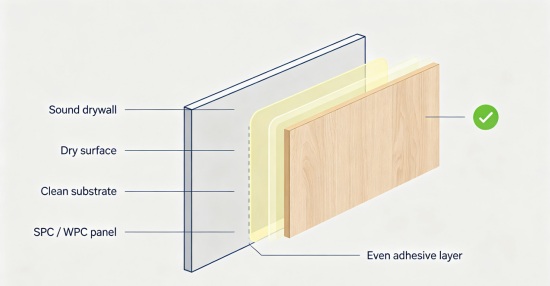
If you’re in the process of renovating your home and you’re looking at a plethora of panels for decoration, the first question to ask is usually the same:can you glue wall panels straight onto drywall, or do you need to frame them first? The answer is simple: the majority of panels that are lightweight, such as SPC or WPC panel walls, are able to be glued directly to drywall, as long as the drywall surface is dry, clean and solid. However, “yes” comes with conditions that must be met, and a mistake is the most common reason why panel installations fail after the first year. We will discuss when glue works, and when it doesn’t and the best way to go about it.
Can You Glue Wall Panels to Drywall? The Short Answer
It is true- yes- the gluing wall panels directly onto the drywall is a common method of installation for light and rigid-core panel types like SPC (Stone Plastic Composite) and WPC (Wood Plastic Composite) wall panels. They work because they are strong and dimensionally stable. They are also light enough that a high-quality construction adhesive can be used to hold the panels without any additional mechanical support. The trick is that the drywall must be solid, dry and free of wallpaper, paint or water damage. If any of these conditions aren’t present, adhesive alone isn’t a solid fix.
What Types of Wall Panels Are Suitable for Gluing
Not every panel material behaves the same way once adhesive is involved.
- SPC and WPC panels — Lightweight, rigid, and dimensionally stable, making them ideal candidates for direct gluing.
- PVC and bamboo charcoal fiber panels — Also glue-friendly due to low weight and consistent surface flatness.
- Solid wood veneer or natural stone-faced panels — Heavier and more prone to expansion, so manufacturers typically recommend a batten system or a combination of adhesive and mechanical fasteners.
- Aluminum honeycomb panels — Structurally rigid but often installed with clips or track systems in commercial settings, since they’re frequently used on larger wall spans where uniform load distribution matters.
As a rule of thumb: the lighter and more moisture-stable the panel, the more suitable it is for a glue-only installation.
What You Need Before You Start
Checking Your Drywall
Press along the surface, look closely for soft spots and check corners for water staining before venting moisture (common in bathrooms and below-grade rooms). Panel manufacturers usually specify an acceptable moisture content for substrate; installing over damp walls could quickly void a warranty agreement.
Choosing the Right Adhesive
Not all adhesives are created equal; panel-specific construction adhesives (typically polyurethane- or MS polymer-based) tend to offer greater flexibility and moisture resistance than generic all-purpose glue. Try not to grab water based adhesives for non porous panel backs, because they set more slowly and the bond can be less dependable, even if it seems fine at first.
Tools You’ll Need
A notched trowel to ensure uniform coverage of the adhesive A level, spacers to fill in gaps in expansion as well as temporary bracing (painter’s props, tape or a panel presses) to keep panels in place while adhesive cures.
How to Glue Wall Panels to Drywall (Step by Step)
- Clean and prepare the wall – Remove dust and grease or loose paint. A lightly sanded and primed surface will improve adhesion.
- Layouts that are dry-fit – Lay out the panels (or indicate positions) prior to applying any adhesive, to ensure that seams and cuts are aligned properly.
- Spread adhesive in a uniform manner– Utilize an oblique trowel to spread adhesive in a regular pattern over the entire panel back and forth, not focusing on the edges or the center.
- Align and press – The panels against walls, then press it firmly and then check the for alignment and level immediately.
- Brace while curing – Use temporary supports for the manufacturer-recommended curing window, typically 24 hours, before removing braces.
- Finish edges and seams – Trim or sealant or match edge profiles when the adhesive is fully set.
Common Mistakes That Cause Panels to Fail
Most panel failures trace back to a handful of avoidable errors:
- Applying adhesive in dots or strips instead of full, even coverage
- Skipping the wall-flatness check, which leaves gaps the adhesive can’t bridge
- Ignoring expansion gaps at edges, causing panels to bow as temperature and humidity shift
- Gluing over a damp or freshly painted wall before it has fully cured
- Removing bracing too early, before the adhesive reaches full strength
Each of these is preventable with basic prep — but skipping any one of them is enough to compromise the bond.
Gluing vs. Mechanical Fixing (Clips, Battens, Screws)
Gluing isn’t always the better choice — it’s the right choice for the right conditions.
| Factor | Gluing | Mechanical Fixing |
| Panel weight | Best for lightweight panels | Better for heavier or oversized panels |
| Wall condition | Requires flat, sound drywall | More forgiving of minor imperfections |
| Removability | Difficult to remove without damage | Panels can be unscrewed or unclipped |
| Speed | Faster for small-to-mid rooms | Slower, but more adjustable during install |
Commercial projects — hotels, offices, high-traffic corridors — often lean toward mechanical or hybrid systems for easier future maintenance, while residential accent walls are frequently glued for a cleaner, seamless look.
When You Should Avoid Gluing Panels Directly
Do not use direct glue if the wall is showing evidence of water damage, especially if the panels are made of heavy natural materials or if the wall will require further access (wiring or plumbing) or in an area with high humidity, such as shower surrounds that do not have an adequate barrier against moisture. In these instances the batten or track system can provide greater flexibility and longer life span for the service.
Choosing the right panel material makes gluing far more predictable. If you’re sourcing SPC or WPC wall panels engineered for stable, adhesive-friendly installation, browse our full range of Decorative Wall Panels to find the right fit for your project.