

Caramel Vein PVC Marble Sheets for Modern Interiors: Design Ideas and Applications
Cool grey and stark white marble dominated interiors for the better part of a decade — but that’s shifting fast. Designers seem to be moving toward warmer, earthier stone vibes, and caramel vein marble is basically sitting right in the middle of that shift. The tricky part is that natural marble in these richer tones tends to be heavy, porous, and honestly pretty costly to put in place. This is where caramel vein PVC marble sheets come in, replicating the look at a fraction of the cost and weight. Here’s how to use the look well, and why the material behind it matters.
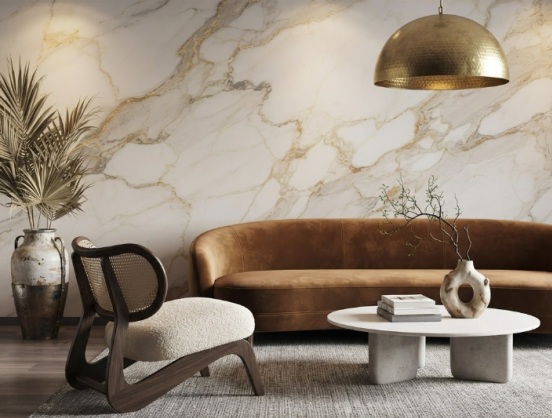
What Is Caramel Vein Marble, and Why It’s Trending
The Warm-Toned Marble Movement in Modern Interior Design
Designers report that clients are gravitating toward nature-inspired warm neutrals — wheat, caramel, terracotta, and warm grays with taupe undertones — describing them as colors that feel cocooning and grounded rather than the cool grays of the past decade. After a decade dominated by “Cool Grey” and “Stark White,” 2026’s leading designers are shifting toward what’s being called “The Golden Hour” — a preference for natural stones that feel inviting, earthy, and rich, with gold and amber veining as the standout trend.
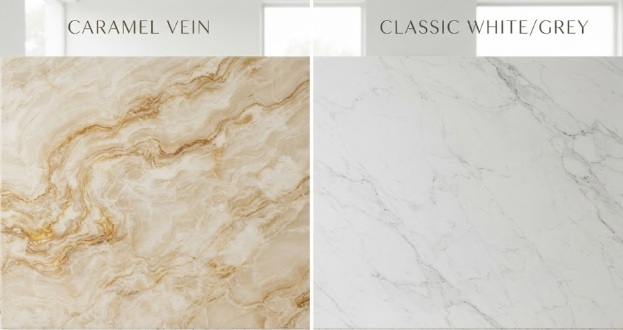
Caramel Vein vs. Classic White/Grey Marble: A Style Comparison
Popular earth-toned marbles right now kind of lean into Crema Marfil (a warm beige from Spain), Emperador (a rich brown with lighter veining), and Breccia Oniciata (peach and caramel tones) — honestly, these are the stones designers keep turning to for beige, taupe, and that soft brown palette vibe; it just makes the spaces feel cozy welcoming. If you compare it with classic white Carrara or Calacatta, a caramel veined marble comes across as way warmer and a bit more casual-luxe, so it matches the wood tones and the more organic textures already show up a lot in modern interiors.
Why PVC Marble Sheets Are Replacing Natural Marble
The Cost and Weight Problem with Natural Marble
Natural marble countertops typically run $40 to $200 per square foot installed, with a full kitchen installation averaging $3,000 to $7,000, and that’s before ongoing upkeep. Natural marble also needs regular sealing roughly once a year plus periodic polishing just to prevent staining and keep its finish — an ongoing cost and maintenance burden most PVC alternatives simply don’t carry.
Weight compounds the installation challenge. Natural marble runs 12 to 18 kg per square foot, while PVC marble sheets weigh only 3 to 4 kg per square foot — roughly 75% lighter, which matters directly for structural loading, transport cost, and how many people it takes to install a panel safely.
| Factor | Caramel Vein PVC Marble | Natural Caramel Marble |
| Waterproofing | 100% waterproof — 0% deformation after 30 days of water immersion | Porous; requires periodic sealing |
| Surface hardness | UV-cured coating rated ≥2H pencil hardness | Prone to etching and staining without sealant |
| Weight | Lightweight; installs directly over existing surfaces | Heavy; often requires structural reinforcement |
| Installation | Cut with standard woodworking tools; no specialist trades required | Requires skilled stone fabricators |
| Maintenance | Non-porous surface wipes clean; no grout lines to harbor mold | Requires regular resealing and specialized cleaning |
| Formaldehyde emissions | E0 grade — zero harmful off-gassing | N/A (natural material) |
How UV-Coated PVC Sheets Replicate the Look Without the Drawbacks
Made with high-resolution digital printing, plus embossing tech, PVC marble boards kind of faithfully recreate the real marble’s natural texture and those flowing veins. And then on top of that, they have solid practical qualities like water resistance, anti-UV ability, and fire safety. UV-cured variants feature a rigid high-gloss protective film that fully encapsulates the marble print. As a result, the caramel veining retains its sharp colour and resists scratches effectively, avoiding the gradual wear and tear seen on standard painted or laminated surfaces.
Design Ideas: Where Caramel Vein PVC Marble Sheets Work Best
Living Room & Feature Walls
A single caramel marble feature wall behind a sofa or media unit instantly warms up a living space without committing to a full-room stone treatment — the panel format makes it achievable as a weekend project rather than a construction job.
Kitchen Backsplashes & Countertop Surrounds
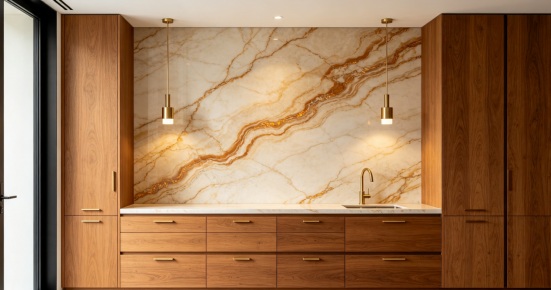
Kitchens are kinda where natural marble’s porosity turns into a real problem, you know, grease acidic foods and that constant daily wiping. It all slowly leaves stains and makes real stone etch over time. A waterproof, non-porous PVC marble backsplash gives you that same caramel-veined visual warmth, just without the sealing routine.
Bathroom & Wet Area Cladding
Constant humidity and standing water make bathrooms one of the toughest environments for natural marble to hold up in without regular resealing. Waterproof PVC marble panels handle full wet-area cladding — shower surrounds included — without the risk of water staining into the stone’s natural pores.
Hotel Lobbies & Reception Areas
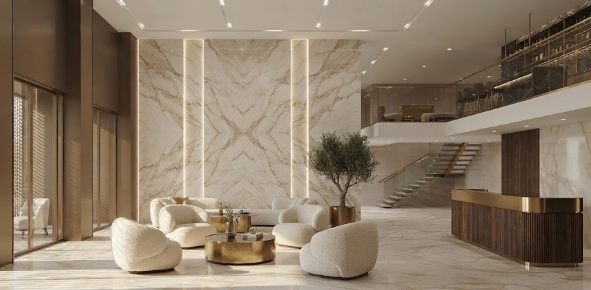
Warm-toned marble that has subtle beige background and gold veining is becoming used in hotel lobby areas precisely because its warm, smoky base lets sunlight into the room and gives it an open and inviting appearance. For hospitality projects that cover large areas of space, PVC marble panels replicate this impression on a commercial scale, without having to face the problems in matching the natural stone veining on dozens of slabs.term use, but often fall short for year-round residence or high-humidity environments.
Pairing Caramel Marble Panels with Other Materials
Complementary Color Palettes (Warm Wood, Brass, Matte Black)
The warm-toned marble is a natural match for hardwood furniture along with brass and copper fixtures. a popular combination for contemporary interior design. Metal fixtures and hardware in matte black give a contrast but don’t compete with the caramel veining and keep the overall look more sane than cluttered.
Lighting Considerations for Marble-Effect Panels
Warm-toned marble reads better under warm white light (2700K-3000K) that highlights the gold and caramel undertones, rather than smoothing them as cooler light bulbs can.
Practical Advantages of PVC UV Marble Board
100% Waterproof and Stain-Resistant Performance
First of all, it stays 100% waterproof, and it also resists stains in a very reliable way. The UV board helps it hold its shape with zero deformation, even after long immersion in water, so it can be used in bathrooms, kitchens, and other high humidity commercial areas without needing extra sealing work or extra treatments.
Scratch Resistance and Long-Term Gloss Retention
The UV-cured top layer achieves pencil hardness of 2H or higher, resisting everyday scratches from keys, utensils, and furniture — a level of durability standard laminate or painted surfaces don’t match, since the color and gloss are locked in permanently rather than sitting as a surface coating that wears off.
Easy Installation Over Existing Surfaces
UV marble boards can be cut using common woodworking tools and then placed directly over walls without demolition or trades. This is a huge benefit against natural stone installations which generally requires specialized construction and support for structural stability.
How to Choose the Right Thickness and Finish for Your Project
Thickness selection should match traffic and exposure level rather than budget alone. Residential accent walls with minimal contact can perform well at 3mm, while commercial spaces — hotel corridors, restaurant walls, retail fit-outs — benefit from 4–5mm panels that hold up better to repeated cleaning and incidental impact. Gloss level is largely an aesthetic choice, though high-gloss finishes tend to suit spaces relying on reflected light, while matte or satin caramel tones work better in spaces aiming for a softer, more textured feel.
Caramel-toned interiors aren’t a passing trend — they reflect a broader move toward warmer, more tactile design language across residential and commercial spaces alike. For projects that want the look of natural caramel marble without its weight, cost, or maintenance demands, UV board offers a practical, design-flexible alternative. If you’re sourcing panels for an upcoming project, Huigong’s UV Board includes caramel and marble-pattern finishes available for sample request and custom OEM development.