

Does SPC Wall Panel Thickness Affect Durability and Installation?
A procurement buyer comparing SPC wall panel quotes notices the same product listed at 3mm, 4mm, and 5mm, with prices climbing noticeably at each step up. The instinct is to assume thicker automatically means more durable and worth the premium. The assumption may not be right. This guide explains the panel thickness that actually affects, as well as what it doesn’t control and why it is important to your project.
Does Thicker SPC Wall Panel Always Mean More Durable?
Not entirely. A thicker plank doesn’t automatically mean a more durable surface — durability against scuffs and scratches comes primarily from the wear layer, a separate protective coating measured in mils, not from the panel’s total thickness. A 3mm-thick panel with adequate wear layer will be as durable as the thicker panels in moderate-to-light use conditions, but the wear layer that is not specified on a heavy panel wears out prematurely. Thickness and durability are linked but they’re not exactly the same thing.
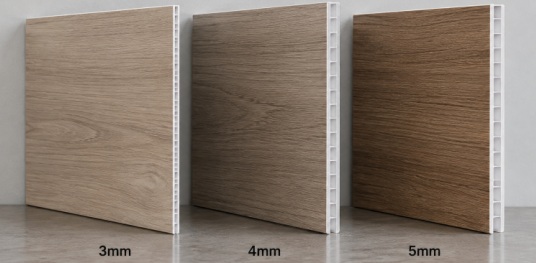
What Does SPC Panel Thickness Actually Affect?
Panel thickness primarily governs the rigid core — the structural backbone beneath the wear layer and decorative film. A denser, thicker core delivers superior resistance to warping or shrinking from temperature and humidity swings, deeper and more secure locking joints, better impact absorption, and greater ability to bridge minor imperfections in the underlying wall surface. In other words, thickness affects structural stability and installation forgiveness far more directly than it affects surface-level scratch resistance.
3mm vs 4mm vs 5mm SPC Wall Panel: Which Fits Which Scenario
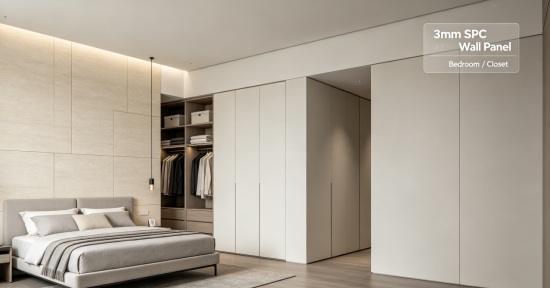
3mm panels are ideal for budget-conscious homes and rooms with lower traffic in which wall motion and impact stress are low such as bedrooms or closets, or walls with accents that receive frequent contact. The downside is that they are less tolerant of substrate The thinner panels have less structural support for uneven surfaces, and so they need a smooth surface beneath. Installing 3mm panel over patches of plaster or concrete is likely to send every flaw through the surface, which makes proper surface preparation non-negotiable in this level of thickness.
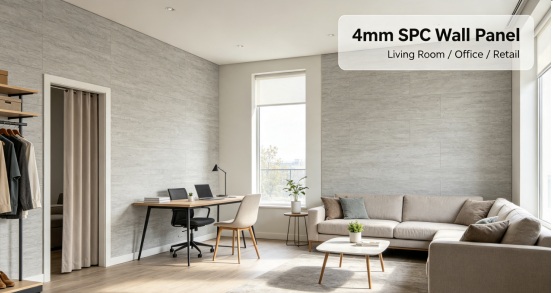
4mm is the most common mid-range choice, and for good reason — it balances cost and performance well enough to serve as the practical default for most standard interior walls, whether residential living rooms or light commercial spaces like small offices and retail fitting rooms. It offers a meaningful step up in rigidity over 3mm without pushing into premium pricing, making it the safe specification when a project doesn’t have unusual demands around traffic, acoustics, or wall condition.
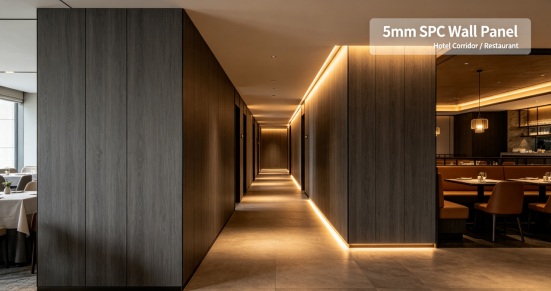
5mm panels are built for more demanding applications: larger panel formats that need enough inherent stiffness to stay flat during handling, high-traffic commercial spaces where daily wear accumulates faster, and hospitality projects like hotel corridors or restaurant walls where impact resistance and sound dampening genuinely matter. The denser core at this thickness also supports deeper, more robust locking profiles, which hold up better against sustained pulling force and the gradual expansion and contraction that comes with temperature fluctuation over years of use — a detail that matters more in commercial settings expected to perform for a decade or longer without visible joint failure.
Does Panel Thickness Change the Installation Method?
The core installation method — tongue-and-groove click-lock, mounted via batten system or direct adhesive — stays consistent across thickness options. What changes is forgiveness, not process. Thicker panels are able to tolerate more unevenness in the substrate before issues show up and thinner panels require flat surfaces for their starting points. The strength of the locking mechanism also depends on the thickness of the core. Thicker boards typically have more shallow locking profiles, which may exhibit small gaps or shift in response to temperature fluctuations, whereas more robust boards produce a wider cross-section of locking that is able to stay solid for a longer period of time. Installation isn’t meaningfully harder with thicker panels — it’s simply more forgiving of real-world wall imperfections.
When Thickness Actually Matters More Than You’d Think
A few scenarios genuinely call for prioritizing thickness. Large-format panels — such as 3000 × 1220mm sheets — need enough inherent rigidity to avoid flexing or bowing during handling and installation, making thinner cores riskier at that scale. Spaces prioritizing sound dampening, like hotel corridors or office partitions, benefit from a denser, thicker core. Also, substrates that aren’t completely flat — such as older walls and uneven plaster, or patched concrete – benefit of a more solid panel’s ability to withstand minor bumps without telegraphing every bump on the final surface.
How to Choose the Right SPC Panel Thickness for Your Project
Start with three questions: What’s the traffic level and impact exposure? How flat is the substrate you’re installing over? And is the panel a standard size or large-format? Budget-sensitive residential projects with flat walls can comfortably specify 3–4mm. Projects for hospitality or commercial use: Large-format panels or poor substrates are reasons to move up to 5mm. If you are unsure, asking for samples of two thicknesses to compare side-by-side is the most reliable method to verify a design prior to making a commitment to a bulk order.
Choosing SPC wall panel thickness isn’t about defaulting to the thickest available option — it’s about matching core thickness and wear layer to your project’s actual traffic, substrate, and panel size requirements. Chongqing Huigong manufactures SPC wall panels in 3mm, 4mm, and 5mm options with free samples available for side-by-side comparison, helping you specify the right thickness before placing a bulk order.