

Glue vs Clips: Which Installation Method Extends Your Wall Panels’ Lifespan the Most?
Choosing the right method for glue vs clips for wall panel installation is one of the most critical decisions when working with modern interlocking panels. The wrong choice can lead to warping, detachment, difficult repairs, or unnecessary damage to the wall surface; the right choice ensures a clean, stable, and durable installation.
The two main methods on the market are adhesive bonding and clip-on (Z-clamp/hanging systems). We’ll explain the applicable scenarios, advantages and disadvantages, and optimal solutions for different types of wall panels from a practical perspective.
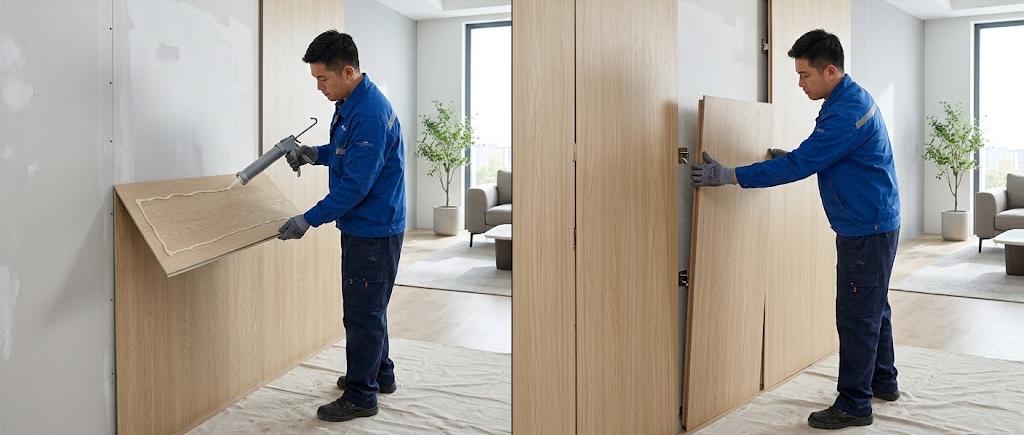
Understanding Glue vs Clips for Wall Panel Installation
There is no single best method for every project. The right choice depends on panel weight, wall condition, humidity levels, temperature fluctuations, and whether future panel removal or maintenance access is required.
The three main options used in professional wall panel installation today are:
- Adhesive (glue) installation
- Clip systems and interlocking methods
- Hybrid installation (clips + limited adhesive)
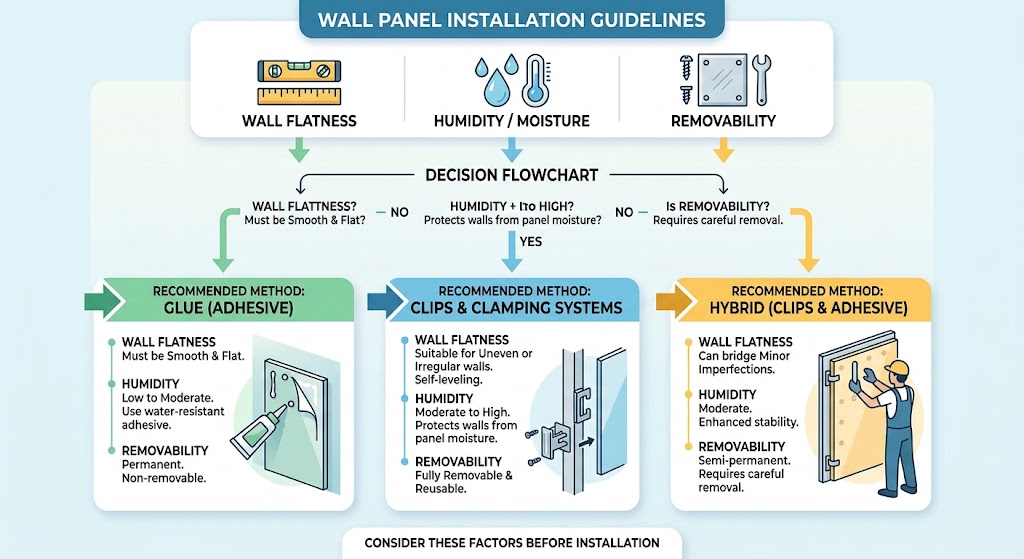
Adhesive (Glue) Installation: Pros, Cons & Best Uses
Apply construction adhesive or mixed polymer adhesive (in strips or “S” shapes) to the back of the board, then press the board firmly against the wall.
Best for: Lightweight or thin boards (many SPC and PVC boards), flat Level 5 drywall or plywood, climate-controlled indoor environments, and projects requiring a completely fastener-free, seamless appearance.
Advantages:
- Fast installation and lower material costs
- No visible hardware
- Fewer tools required
- Good adhesion with modern polymer adhesives
Disadvantages:
- Permanent bond – removal almost always damages the wall surface
- Requires a very smooth, clean, and dry wall surface
- Limited resistance to thermal expansion and contraction
- Higher risk of detachment in damp areas or with large temperature fluctuations
- Not suitable for heavy or large-format panels
Clip Systems and Interlocking Methods Explained
Part of the buckle is fixed on the wall (or keel), the corresponding part is fixed on the plate, and the plate is clicked into place. Many modern SPC and WPC systems feature integrated tongue and groove construction with either hidden snaps or screws driven through slots.
Best for: Heavier boards, solid wood or acoustic panels, commercial spaces, uneven walls, and projects that require separate removal or future maintenance access.
Advantages
- The panels can be removed and replaced without damaging the wall surface
- Forming a small air layer is conducive to moisture-proofing and thermal expansion and contraction management
- With the keel can be used on the imperfect wall
- Better long-term stability under temperature changes
Disadvantages
- High cost of hardware
- Precise layout and fixation to the keel or expansion anchors are required.
- Will slightly increase the thickness of the wall
- The installation time on simple and flat walls is slightly longer.
Hybrid Installation: Combining Clips and Adhesive
Mechanical snap-on fasteners bear the main load and allow movement, while a small amount of adhesive is used to prevent rattling or slight displacement.
Best for: Large-format panels, exterior or high-volume applications, aluminum honeycomb panels, and projects requiring both robustness and future maintainability.
Decision Guide: Glue vs Clips for Different Wall Panels
| Factors | Pure glue | Latch / Interlock System | Mixing method |
| Panel weight | Light to medium | Medium to Heavy | Medium to heavy |
| Wall flatness | Must be very good | Acceptable (compatible with keel) | Tolerable |
| Humidity / Moisture area | High risk | Good | Best |
| Expansion and contraction due to heat and cold | Poor | OK | Excellent |
| Removability | Destructive | Easy | Easy |
| Installation speed (perfect wall) | The fastest | Medium | Medium |
| Long-term failure risk | Higher | Lower | Minimum |
| Typical cost | Minimum | Medium | Medium – High |
How To Choose The Installation Method for Different Wall Panel Products?
Huigong, as a factory that produces and sells various types of modular wall panels, has provided some suggestions for the products we currently sell, namely SPC wall panels, WPC wall panels, and aluminum honeycomb panels:
Best Way to Install SPC Wall Panels
If renovating on a flat tile surface, using glue is acceptable, with the lowest cost and cleanest effect.
If working on an old latex paint wall with slight peeling or hollowing out, it is strongly recommended to use clips. Because the glue adhering to an unstable base is useless glue, it will fall off sooner or later. The clips directly penetrate the wall body, and the force is independent of the surface layer.
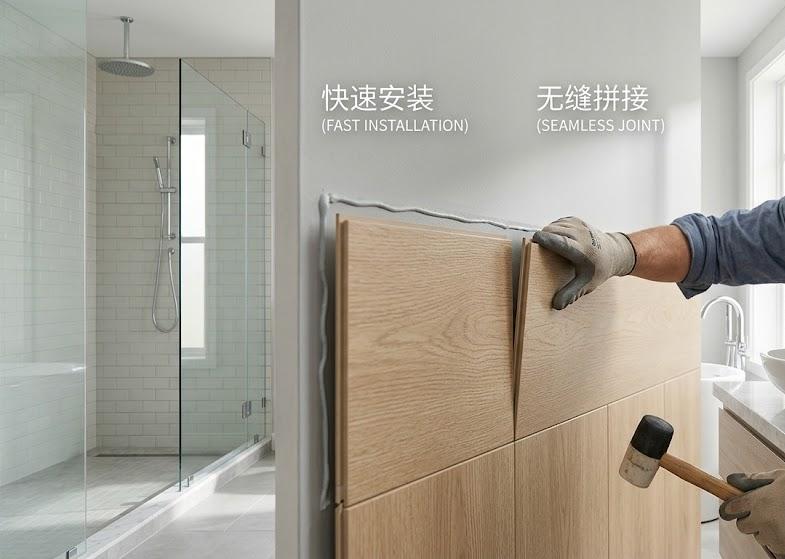
WPC Wall Panel Installation Methods
Pure glue installation is not recommended. The inherent properties of WPC (Wood Polycarbonate) mean it exhibits a relatively significant expansion and contraction response to temperature changes. Glue tightly constricting the board can easily lead to warping or widening gaps.
Best solution: Clip-on system. This allows the board to “float,” with an air layer behind it allowing for free expansion and contraction. This results in the longest lifespan and the most stable appearance.
Aluminum Honeycomb Panel Mounting Options
It is necessary to adopt a “clip-bearing + glue-assisted” mixed solution. Large-format aluminum honeycomb panels have a relatively heavy self-weight, and the clips are responsible for the main force to prevent falling; structural glue is used at local points to assist in bonding, preventing the panel surface from shaking or making abnormal sounds due to external force. This approach combines safety and flatness, and is currently the recognized optimal solution for installing large-sized panels.
Conclusion
There is no single method that suits all wall panel projects. Glue provides speed and simplicity on an ideal base; snap-in and interlocking systems offer better long-term performance, especially for WPC, large panels, and imperfect walls; and the hybrid approach combines the advantages of both.
For manufacturers and suppliers of interlocking SPC, WPC, and aluminum honeycomb panels, the most reliable recommendation is usually a well-designed mechanical or hybrid system. It can reduce warranty issues, enhance customer satisfaction, and truly bring out the performance advantages of these modern materials.