

How to Choose the Right PVC Panels for Ceiling Applications
Visit any building supply showroom and you’ll see a variety of PVC ceiling panels that appear similar in pictures; however, they perform differently when installed. Choose the wrong one and you could end up with sagging panels, trapped water, or a product that doesn’t pass an inspection for fire. Following, we break the decision into six practical factors — application, thickness, moisture resistance, fire rating, finish, and installation method — so you can evaluate any PVC ceiling panel with confidence before you commit to an order.
Start With the Application: Where Is the Ceiling Panel Going?
Before comparing specs, define the environment the panel will live in — this single decision shapes every parameter that follows.
- Bedrooms and living rooms in residential homes prefer a panel made of lightweight material that is easy to move and easily installs over ceiling joists that are standard.
- Bathrooms, kitchens, and balconies that are covered require strong water and mold resistance over anything else, because condensation and humidity are always present.
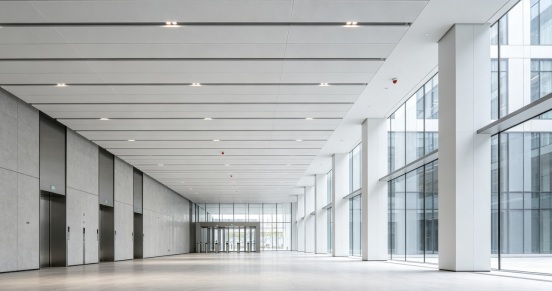
- Public and commercial spaces, including retail stores, offices parking structures, offices require fire-proof sheets that could be erected quickly across large spans, while still meeting the regulations.
Once you’ve identified the category your project is in, then the selection process is more precise.
Panel Thickness: Balancing Weight, Rigidity, and Cost
Thickness is the primary spec buyers look at, and with reasons that are valid — it directly impacts the rigidity, insulation and the amount of sag the board will withstand in time. PVC ceiling boards generally are between 6 and 12 mm in thickness which impacts both rigidity and insulation performance. The thinner panels at the lower portion of that range work well for light residential retrofits where ceiling grids are limited in capacity for load, however they are more flexible in the face of their own weight over longer lengths. Thicker panels can hold their shape more effectively over large areas and are resistant to damage from impact which makes them a safer option for commercial ceilings or rooms with extreme humidity swings that could cause thin materials to be warped.
A good rule of thumb is to verify the actual thickness against the nominal measurement given by a manufacturer, as small differences between the measured and listed dimensions are not uncommon on the market and could impact how panels are incorporated into grids that are already in place.

Moisture Resistance and Anti-Mold Performance
Ceilings face a unique humidity problem than wallscondensation can form from above, which is usually not spotted until sagging or staining appears. PVC is water-resistant in nature as a material base however, its real-world performance is dependent heavily on the density of the panel seams, seam designs, and the treatment of the surface, not the raw material itself.
Quality panels are made of an impervious, sealed construction that stops water from getting through the seams. This is the reason why they stop growth of mold and bacterial as time passes. Porous or hollow core panels are more susceptible to moisture that is trapped beneath the layer. For kitchens, bathrooms or basements, inquire with the suppliers to test their products with third-party labs instead of relying on advertising claims. This is because the performance of moisture is different for each manufacturer regardless of the thickness.
Fire Rating: A Non-Negotiable for Commercial Projects
Fire performance is where PVC ceiling panels are most frequently misjudged, and it’s an area where cutting corners has real safety consequences. Two widely used fire rating tests for classifying the flame retardance of PVC ceilings are the ASTM E84 and EN 13501-1 tests, both of which evaluate flame spread and smoke development rather than simple combustibility.
For context, the acceptable range for a Class A fire rating is a flame spread index of 0–25 and a smoke-developed index of 0–450 — the benchmark most commercial ceiling specifications require. PVC ceilings generally exhibit good fire performance due to a self-extinguishing nature driven by fire-retardant additives incorporated during manufacturing, but this property varies by formulation, so it should never be assumed by default. Because ceilings sit directly above occupants and can obstruct smoke detectors or sprinkler coverage if installed incorrectly, always request the specific certification number and test report — not just a general claim of “fire-rated” — before approving a bulk order for any commercial space.
Surface Finish and Design Flexibility
When performance requirements are established aesthetics will be the main aspect between products that are comparable. The most common finishes are UV-printed designs to create custom branding or décor themes wood-grain laminate films and gloss or matte surfaces.
Since ceilings are seen from below at an upward angle, therefore, light interacts with the ceiling in a different way as it would on the wall. The matt or slightly textured surfaces can hide seam lines and block the glare of overhead fixtures more than high-gloss surfaces that could visually accent each joint of the ceiling. Commercial projects that span multiple locations – hotels and retail franchises, as well as restaurants, etc.custom-designed UV-printed patterns can be used to create a uniform look for the appearance of ceilings across each location that is sourced from one production line.
Installation Method: Clip System vs. Adhesive Mounting
The two main installation techniques both offer different advantages. Clip and track systems are helpful because individual panels can be taken out and swapped without messing up the nearby ceiling, which is kinda important in commercial buildings where electrical, HVAC, or plumbing lines above the ceiling sometimes need attention. Adhesive mounting creates a more streamlined and more seamless look that is popular in residential areas where a neat, minimalist design is more important than access to the future.
The two methods aren’t necessarily “better” — the most appropriate choice is determined by what you want from your project: the highest quality end or long-term durability.
How to Evaluate a PVC Ceiling Panel Supplier
Even if panel is well described on paper it can still underperform when the supply line is inconsistent. Before you lock in your order, just check four things, and don’t rush through them:
- Factory ownership is a matter of whether the manufacturer have its own manufacturing facility, or is it an intermediary that resells from several factories? Direct manufacturers typically offer tighter quality control and more reliable lead times.
- Independent certification — ISO and SGS certifications provide third-party verification of both quality management and specific performance claims like fire and moisture resistance.
- Sample and customization support — reputable manufacturers should offer free or low-cost samples before committing to a bulk order, along with the flexibility to customize dimensions or finishes for larger projects.
- Technical and after-sales support — installation guidance and responsive troubleshooting matter most once panels are already on-site, not just during the sales conversation.
A manufacturer that has its own factory and documented certifications typically ensures more consistency in quality and reliability of delivery than a reseller who coordinates several production lines of third parties.
Key Takeaways
Match panel thickness to your ceiling’s span and load conditions — thicker isn’t always necessary, but under-specifying leads to sagging
Prioritize moisture resistance and sealed seams for kitchens, bathrooms, and humid climates
Never accept a general “fire-rated” claim — request the ASTM E84 or EN 13501-1 test report directly
Choose a finish suited to upward viewing angles and your lighting setup
Confirm whether you need serviceability (clip system) or a seamless look (adhesive)
Vet your supplier’s factory ownership and certifications before placing a bulk order
Before committing to a full production run, request a free sample and test it against your project’s actual conditions — thickness, moisture exposure, and lighting — rather than relying on a spec sheet alone. If you’re sourcing PVC ceiling panels for an upcoming project, contact us to discuss thickness options, fire-rated certifications, and custom finish samples suited to your specific application.