

RV Interior Wall Panels: Best Materials for Your Camper
Picking the appropriate RV interior wall panels is kind of one of those big decisions, during renovation or new build, no kidding. It affects the overall look and feel, but it also has to handle vibrations while the vehicle is moving, plus the constant swings in temperature and humidity, and honestly the interior space is kind of tight too. So choosing RV interior wall panels is not just about going with a nice color, or whatever looks good on the price tag—there’s more going on. You really have to think through things like the weight, the ability to resist moisture, durability over time, the way it gets mounted or installed, and even the maintenance costs after.
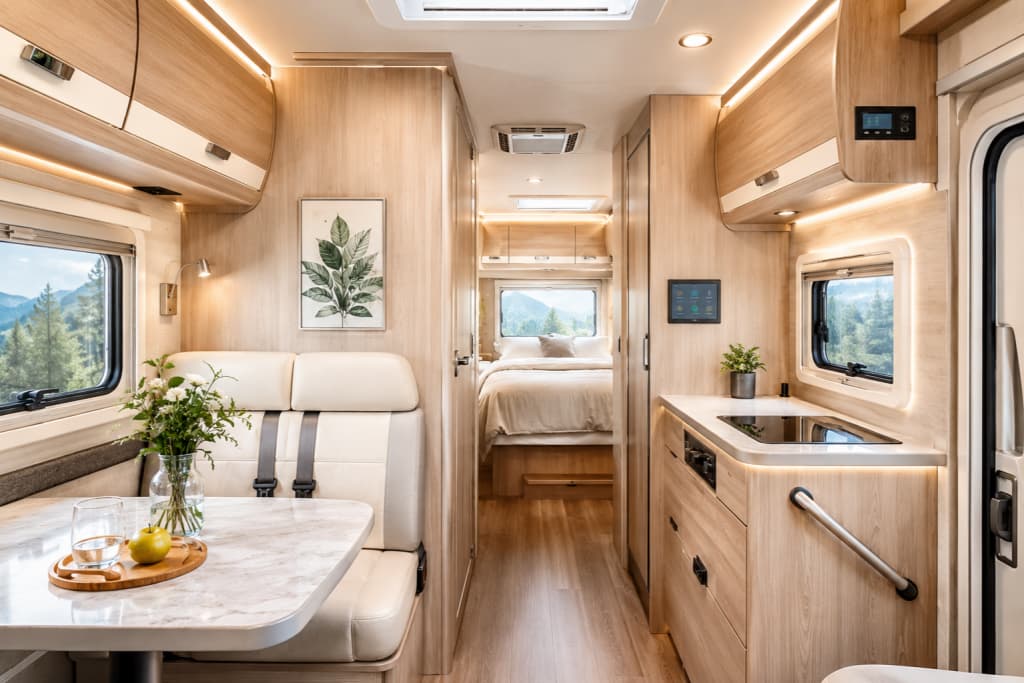
Why Are RV Interior Wall Panels So Important
An RV is a mobile home. It must withstand constant vibration, extreme temperature fluctuations, humidity, and limited structural load capacity. Interior wall panels endure far more stress than most people expect. Slow leaks behind windows can ruin traditional plywood within months. Excess weight reduces payload capacity and affects fuel efficiency. Poor-quality materials may also emit unpleasant odors or fail to handle the damp conditions common in tight spaces.
Choosing the right wall panel protects your investment, keeps your interior looking great for years, and enhances daily comfort.
Unique Challenges Of RV Interior Wall Panels
Before comparing the materials, let’s first understand the environment they must deal with:
- Water intrusion – Roof leaks, window seal failures, and condensation water are the top killers of the interior of recreational vehicles. Moist materials will expand, delaminate, and breed mold.
- Vibration and movement – Continuous road vibrations will loosen fasteners, open joints, and cause brittle materials to crack.
- Weight limit – Every additional kilogram reduces cargo capacity and affects handling and fuel consumption.
- Extreme temperature changes – Materials expand and contract with temperature. Poor dimensional stability can lead to bulges or gaps.
- Indoor air quality – Recreational vehicles are enclosed environments. Low VOC levels have a significant impact on full-time occupants.
These challenges explain why many factory-fitted eucalyptus boards or medium-density fiberboards fail prematurely, and also explain why modern composite materials are becoming increasingly popular.
Key Factors In Choosing RV Interior Wall Panels
Ranked by the importance perceived by most owners:
- Moisture and water resistance
- Weight
- Earthquake resistance and durability
- Easy to clean and maintain
- Environmental and health performance (formaldehyde release, odor)
- Fire resistance grade
- Long-term cost and lifespan
- Installation convenience and aesthetic options
- Insulation and soundproofing performance
No material can excel in all aspects. The best choice depends on your climate, usage pattern (weekend use vs. full-time use), budget, and the issue you want to prioritize the most.
Traditional Materials vs. Modern Composite Material Solutions
The traditional options are still commonly seen in many recreational vehicles and old renovation projects:
- Laminated wood / eucalyptus board – lightweight and inexpensive, but poor at moisture resistance. Once water gets in, the entire board often needs to be replaced.
- Medium-density fiberboard (MDF) – smooth surface suitable for painting, but prone to swelling when exposed to water.
- Vinyl – affordable and easy to clean, but becomes brittle and develops wear marks over time.
- Regular aluminum sheet or basic FRP – good at moisture resistance, but aluminum sheets tend to dent and conduct heat and noise; FRP joints remain weak points.
These materials are acceptable in dry climates or for short-term use, but often fall short for year-round residence or high-humidity environments.
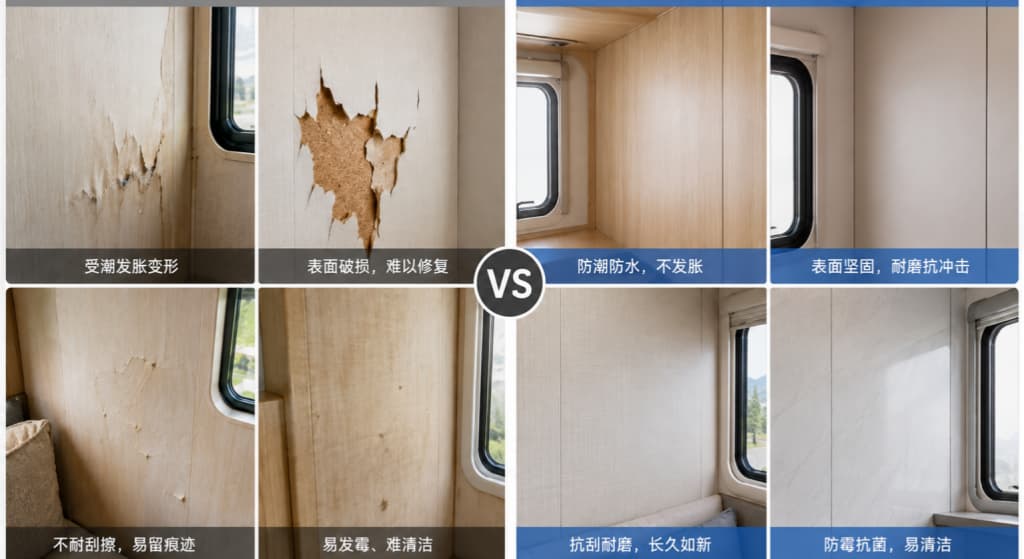
Modern composite wall panels have addressed the core weaknesses of traditional materials. The following four materials have performed exceptionally well in the interior design of recreational vehicles:
| Material | Moisture Resistance | Weight | Health & Eco Performance | Vibration Durability | Fire Rating | Best For |
| WPC Wall Panels | Excellent | Light | Low formaldehyde (E0) | Good | B1 | Living areas, overall interior |
| SPC Wall Panels | 100% waterproof | Medium | Low formaldehyde (E0) | Excellent | B1 | Kitchens, high-traffic zones |
| Aluminum Honeycomb Panels | Excellent | Very light | Formaldehyde-free | Outstanding | B1 | Weight-critical builds, large panels |
| Bamboo Charcoal Fiber Panels | Excellent | Light | Absorbs odors & formaldehyde, antimicrobial | Good | B1 | Bedrooms, full-time living, air quality focus |
Why Do There Modern Materials Perform Better in RVs
WPC (wood-plastic composite) wall panels offer a natural wood grain appearance while possessing excellent water resistance and dimensional stability. They are easy to install, resistant to mold, have high cost-effectiveness, and are suitable for most interior walls.
SPC (stone-plastic composite) wall panels are made with high-density stone powder and PVC core, and are extremely rigid and highly wear-resistant. They can effectively withstand impacts and vibrations and are fully waterproof – perfect for damp areas or high-frequency usage areas.
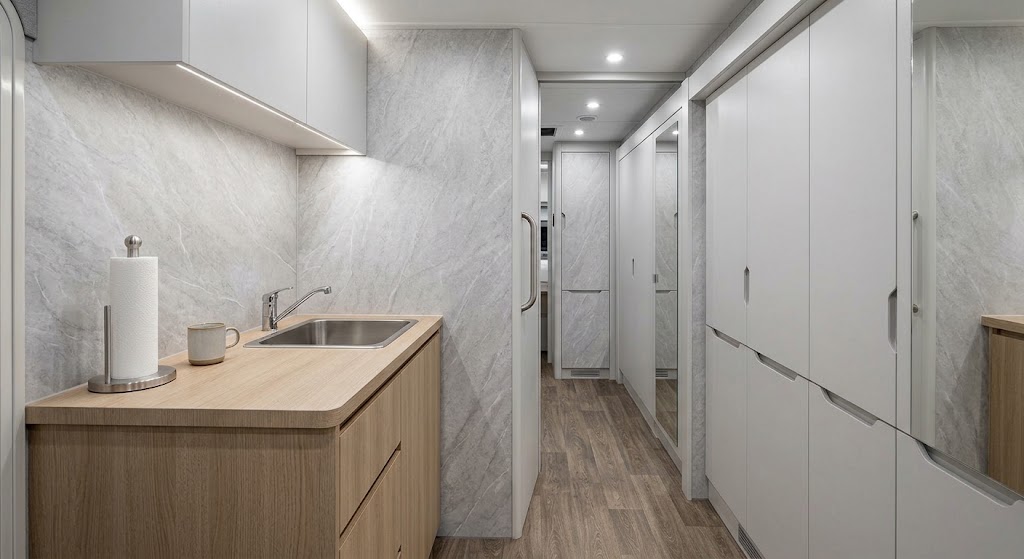
Honeycomb aluminum panels achieve an outstanding strength-to-weight ratio. The honeycomb core makes the panels extremely lightweight, while having strong resistance to deformation. Large-area installation still maintains a flat surface. It is particularly useful when payload is critical.
Bamboo Charcoal Fiber Panels offer additional health benefits. Bamboo charcoal helps absorb odors, moisture, and pollutants in the air, and is also mold-resistant and antibacterial. In a closed RV environment, this can provide fresher air and a more comfortable living experience. Many versions meet low formaldehyde or zero formaldehyde standards, and can be occupied immediately after installation.
These materials can be used in combination in different areas – for example, using SPC or honeycomb aluminum panels in the kitchen and bathroom, WPC in the living area, and bamboo charcoal fiber panels in areas that prioritize air quality.
How to Match Suitable Materials According to Needs
Full-time residence – Prioritize moisture resistance, air quality and durability. Bamboo charcoal fiberboard and SPC wall panels perform exceptionally well.
Weekend or seasonal use – WPC usually achieves the best balance between appearance, cost and performance.
Damp or coastal climate – Avoid traditional plywood and MDF. Choose SPC or honeycomb aluminum panels, etc., as completely waterproof materials.
Weight-sensitive vehicles – Honeycomb aluminum panels can minimize weight without sacrificing strength.
Budget considerations – WPC usually offers the best value for money; SPC and honeycomb aluminum panels have higher initial costs but lower long-term maintenance costs.
Damp areas vs living areas – Bathrooms and kitchens should prioritize SPC or honeycomb aluminum panels; bedrooms and main living spaces can choose WPC or bamboo charcoal fiberboard.
Installation Notes
Accurate measurements are crucial—RV walls are often curved and space is limited. Huigong interior wall panels offer curved options to wrap round columns.
Prefer mechanical snap-fit systems or shock-resistant adhesives and fasteners over simple nails. Allow adequate expansion gaps and carefully seal all seams. Lightweight panels facilitate handling and reduce structural stress. Ensure new wall panels fit well with existing frames, insulation, and cabinetry.
Common mistakes include insufficient sealing, ignoring expansion gaps, and adding unnecessary weight due to excessive material thickness.
Conclusion
There is no absolutely “best” interior wall panel for a caravan – only the materials that are most suitable for your specific situation. Traditional plywood, MDF and basic vinyl are still acceptable in projects with limited budgets, dry climates and occasional use. But for most modern caravanners, composite materials have significant advantages in terms of moisture resistance, weight, durability and health performance.
WPC wall panels are an excellent all-round choice for the living area. SPC wall panels are suitable for demanding damp and high-traffic areas. Honeycomb aluminum panels solve the problems of weight and rigidity. Bamboo charcoal fiber panels improve air quality in the enclosed environment of the caravan.
Matching the material performance with the real usage pressure of the caravan allows you to protect your investment, reduce future maintenance, and create a more comfortable mobile home.