

SPC Flooring vs Laminate: Which Is Better in 2026?
You’re standing in the flooring aisle, staring at two samples that look nearly identical. Both have beautiful wood grain patterns. Both click together without glue. Both promise durability and style.
But here’s the truth: the SPC flooring vs laminate debate starts with understanding that they’re completely different products.
One is made of stone and plastic. The other is made of wood fibers and resin. And choosing the wrong one for your space could cost you thousands in water damage—or leave you disappointed with dents and scratches within a year.
In this comprehensive guide, we’ll break down everything you need to know about SPC vs laminate flooring. By the end, you’ll know exactly which one belongs in your home—and which one to avoid for your specific situation.
What Exactly Are These Floors?
To answer the question of SPC or laminate which is better, you first need to know what each one is made of.
What is SPC flooring made of?
SPC stands for Stone Plastic Composite—and the name tells you everything.
Core Composition:60-70% Limestone powder (the “stone”)+20-30% PVC resin (the “plastic”)+10% Stabilizers and additives
What is laminate flooring made of?
Laminate is essentially a photographic image of wood fused to a high-density fiberboard core.
Core Composition:High-Density Fiberboard (HDF) – Made from compressed wood fibers and resin+Melamine resin – Binds the layers together
The 7 Critical Differences
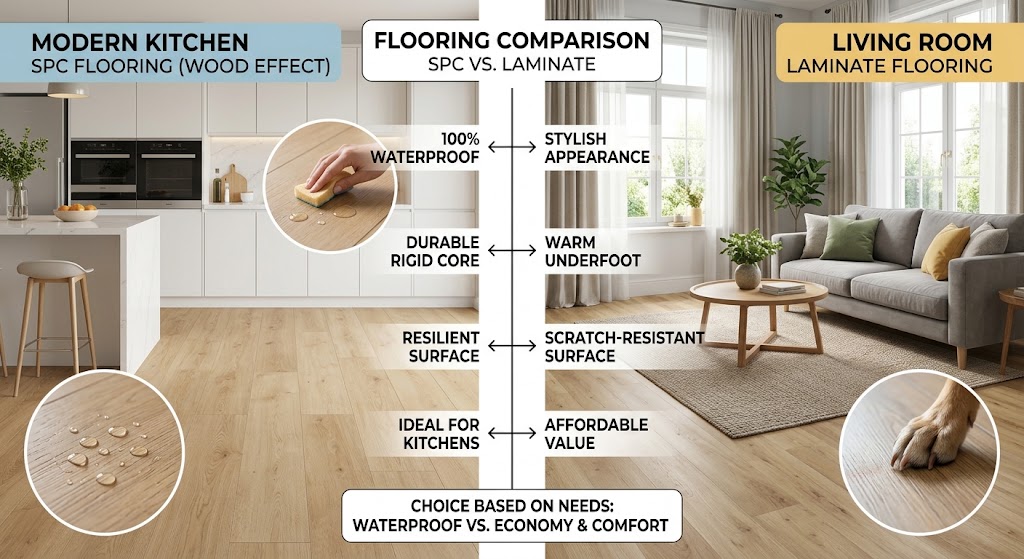
Difference #1: Waterproof Performance—This Is the Game-Changer
This single factor alone determines 80% of buying decisions.
| Aspect | SPC Flooring | Laminate Flooring |
| Core Material | Stone + plastic (inorganic) | Wood fibers (organic) |
| Water Absorption | 0% absorption | Absorbs moisture like a sponge |
| Response to Water | Unaffected—water sits on surface | Swells, delaminates, warps, molds |
| Suitable Areas | Kitchens, bathrooms, basements, laundry rooms | Living rooms, bedrooms, dining rooms (low moisture) |
The Hard Truth:
SPC flooring is 100% waterproof. You can submerge it in water for 48 hours, and it won’t change dimension or degrade.
Laminate is only surface-water-resistant. If water seeps into the seams or edges, the HDF core absorbs it like a sponge, causing the planks to swell, buckle, and develop black mold at the joints. Even “waterproof” laminate only has a water-resistant coating on top—the core is still vulnerable.
Pro Tip: If you’re installing in a basement, kitchen, or anywhere near water sources, SPC is your only safe bet.
Difference #2: Scratch and Wear Resistance—Who Wins the Durability Test?
Both floors are durable, but they excel in different ways.
| Aspect | SPC Flooring | Laminate Flooring |
| Surface Hardness | Depends on wear layer thickness (0.3–0.7mm) | Rated by AC (Abrasion Class) scale |
| Scratch Resistance | Moderate to good | Excellent to outstanding |
| Indentation Recovery | Minimal rebound | Some rebound (wood compresses and recovers slightly) |
The Hard Truth:
Laminate is significantly more scratch-resistant than SPC. High-quality laminate with an AC4 or AC5 rating can withstand commercial traffic, heavy furniture dragging, and even pet claws without visible damage.
SPC, despite its “stone” name, is actually softer. It’s vulnerable to:
- Heavy furniture legs without felt protectors
- Dropped cast-iron pans
- Pet nails on high-gloss finishes
- High heels with worn tips
But here’s the twist: SPC handles point-load pressure (like heavy refrigerators or pianos) better than laminate because it doesn’t compress. Laminate can dent under extreme point pressure.
Difference #3: Comfort and Underfoot Feel—Night and Day
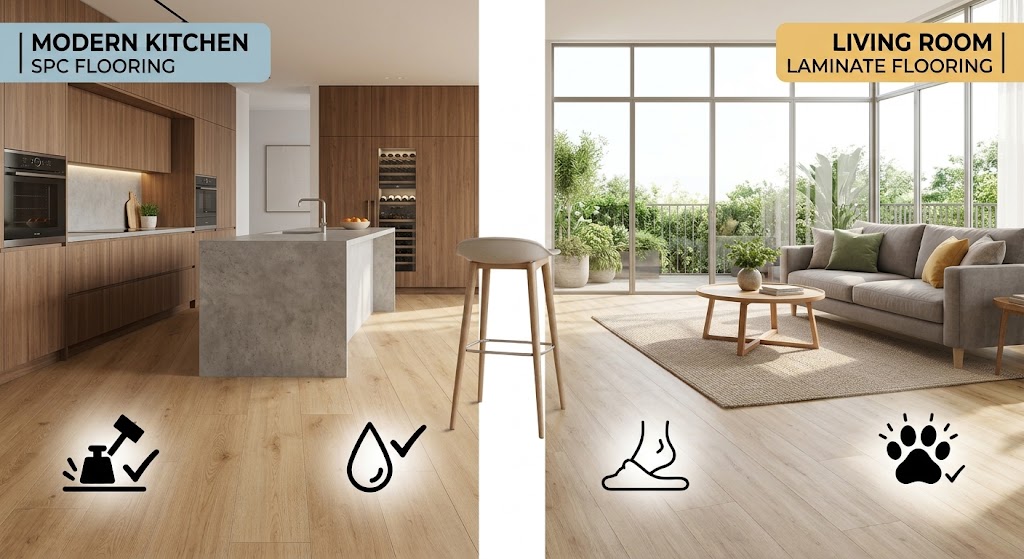
This is where material science directly affects your daily experience.
| Aspect | SPC Flooring | Laminate Flooring |
| Feel | Hard, cold, stone-like | Warm, slightly resilient, wood-like |
| Spring/Resilience | Minimal—feels like tile | Moderate—wood fibers give some bounce |
| Temperature | Cold to the touch (thermally conductive) | Warmer to the touch (wood is insulating) |
| Walking Sound | Hollow, slightly echoey | Dense, solid, satisfying thud |
| Underlayment Effect | Pre-attached foam pad reduces hollow sound | Requires separate underlayment for sound reduction |
The Hard Truth:
If you love barefoot walks on a cozy floor, laminate wins hands-down. SPC feels like “premium tile”—hard, cold, and slightly clicky.
Comfort Comparison Table:
| Scenario | Winner |
| Barefoot walking in winter | Laminate |
| Standing for long periods (kitchen) | Laminate (better shock absorption) |
| Heated floors (radiant heat) | SPC (conducts heat efficiently) |
| Sound transfer to downstairs | SPC (attached pad reduces impact noise) |
Difference #4: Installation—Both Click, But One Is Finicky
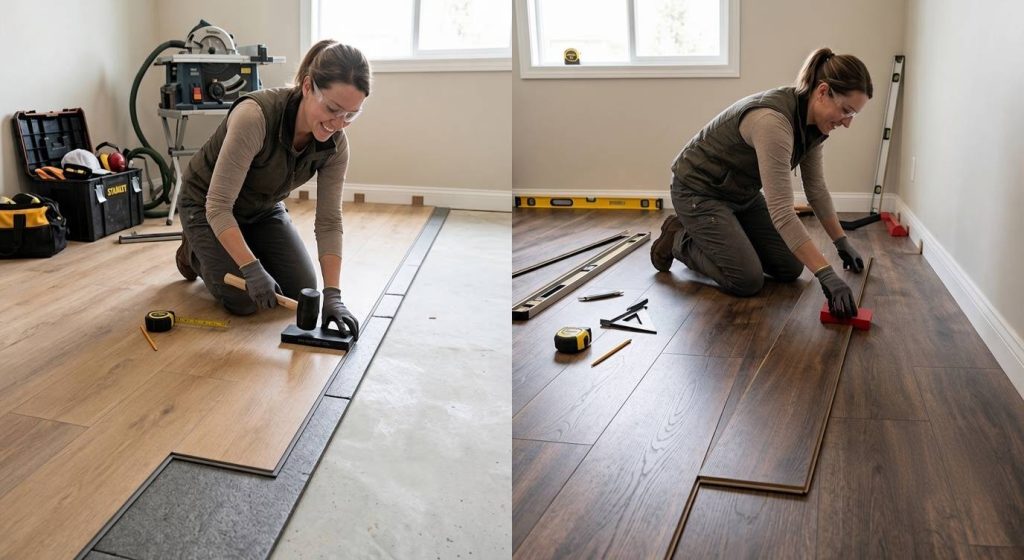
Both floors use the click-lock (floating floor) system. No glue, no nails, just angle-and-lock. But don’t let that fool you—the prep requirements are completely different.
| Aspect | SPC Flooring | Laminate Flooring |
| Installation Method | Floating click-lock | Floating click-lock |
| Floor Flatness Required | Extremely strict (< 3mm over 2 meters) | Moderate (< 5mm over 2 meters) |
| Underlayment Needed | Pre-attached (no additional needed) | Required (sold separately) |
| Cutting Tools | Utility knife + straight edge (score and snap) | Saw (circular or miter) |
| Expansion Gap Required | Minimal (3-5mm around perimeter) | Moderate (8-12mm around perimeter) |
| DIY Difficulty | Challenging—rigid planks don’t forgive uneven subfloors | Moderate—more forgiving |
Difference #5: Sound and Acoustics—The Walking Experience
No one wants a floor that sounds like a drum when you walk across it.
| Aspect | SPC Flooring | Laminate Flooring |
| Impact Noise (footsteps) | Dampened by attached IXPE pad | Depends on underlayment quality |
| Tone of Footsteps | Lower frequency, “thumping” | Higher frequency, “clicking” |
| Hollow Echo | Noticeable (especially on concrete subfloors) | Less echo (denser core) |
| Sound Transmission to Lower Floors | Good (pad absorbs impact) | Variable (depends on underlayment) |
| Room-to-Room Sound | Moderate—sound travels through rigid core | Better—dense core absorbs more |
The Hard Truth:
SPC has a hollow, drum-like sound that many homeowners find annoying. Even with the pre-attached pad, the rigid stone-plastic core doesn’t absorb sound waves like wood fibers do.
Laminate with a high-quality underlayment (like 3mm foam or cork) sounds much more solid and premium underfoot.
Sound Test Results (Decibel Reduction):
| Floor Type | Impact Noise Reduction |
| SPC (with 1.5mm IXPE pad) | ~15 dB reduction |
| Laminate (with 3mm foam underlayment) | ~19 dB reduction |
| Laminate (with 5mm cork underlayment) | ~25 dB reduction |
Pro Tip: If you have downstairs neighbors or loud children, invest in laminate with premium underlayment. If you’re installing on a concrete slab, SPC’s attached pad provides sufficient sound dampening without extra layers.
Difference #6: Health, Safety, and VOCs—What’s In Your Floor?
This is an under-discussed topic that affects indoor air quality.
| Aspect | SPC Flooring | Laminate Flooring |
| Primary Concern | Phthalates (plasticizers) + Heavy metals | Formaldehyde emissions |
| Off-gassing | Low if high-quality (phthalate-free) | Moderate to high (depends on resin quality) |
| Certification to Look For | FloorScore, REACH compliance, No Phthalates | CARB Phase 2, E1, Greenguard Gold |
| Fire Resistance | Good (stone content inhibits flame) | Moderate (wood fibers burn) |
| Chemicals of Concern | PVC, stabilizers, plasticizers | Urea-formaldehyde glue |
| Best for Allergy Sufferers | Excellent (no organic matter for mold) | Good (but moisture can trigger mold) |
The Hard Truth:
Laminate’s dark secret: Cheap laminate can emit formaldehyde for years. Formaldehyde is a known carcinogen and can trigger respiratory issues. Always look for CARB Phase 2 or E1 certification.
SPC’s dark secret: PVC production involves phthalates (endocrine disruptors) and heavy metals (lead, cadmium) as stabilizers. Cheap SPC can have a “plastic smell” and off-gas VOCs. Look for phthalate-free and FloorScore certified products.
Health Comparison:
| Scenario | Safer Choice |
| Children’s bedrooms | High-quality SPC (low VOC, no formaldehyde) or E1 laminate |
| Kitchen with food prep | SPC (sealed surface, no exposed wood) |
| Basement with humidity | SPC (mold-resistant) |
| Home with asthma sufferers | SPC (no organic dust from wood fibers) |
Pro Tip: Always ask for the material safety data sheet (MSDS) and third-party test results. If the retailer can’t provide them, walk away.
Difference #7: Cost, Value, and Lifespan—The Bottom Line
Let’s talk money—the deciding factor for many homeowners.
| Aspect | SPC Flooring | Laminate Flooring |
| Price Range (materials) | $3 – $8 per sq. ft. | $1.5 – $6 per sq. ft. |
| Price Range (installed) | $6 – $13 per sq. ft. | $4 – $10 per sq. ft. |
| Expected Lifespan (Residential) | 10 – 20 years | 15 – 30 years (high-quality) |
| Maintenance Cost | Low (easy to clean) | Low (but refinishing not possible) |
| Resale Value Impact | Good (perceived as premium) | Moderate (perceived as budget) |
| Repair Difficulty | Moderate—can replace individual planks | Difficult—color matching discontinued styles |
Aesthetics and Style—Which Looks Better?
Real–world Wood–grain Appearance
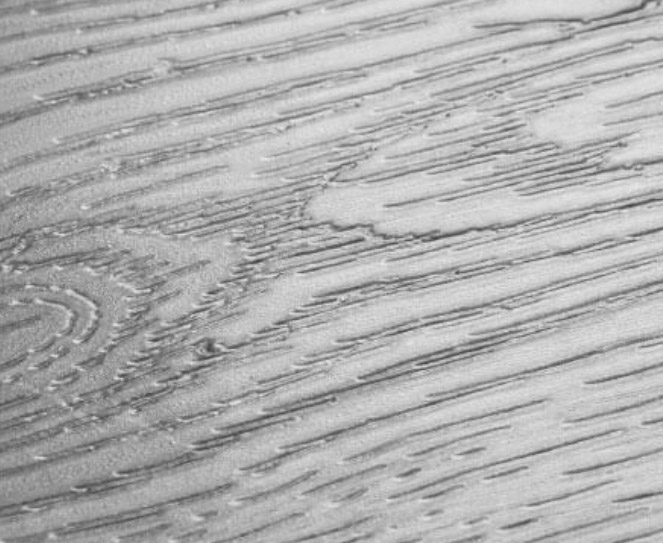
Laminate flooring generally delivers more authentic wood-like visuals, mainly thanks to EIR (Embossed–in–Register) technology. It precisely aligns the wood-grain decor paper with embossing plates for realistic effects both visually and tactilely.
- Three-dimensional feel: It creates natural wood-groove depth, simulating uneven growth rings and wood knots for a genuine wood touch.
- Rich decors: Wide selections of wood species and interior styles. High-end versions have low pattern repetition for more natural flooring results.
- Surface treatments: Hand-scraped, brushed and carbonized finishes reduce printed-look stiffness with subtle variations between planks.
Mid-to-high-end SPC flooring now also adopts EIR for textured wood-grain surfaces. Still, material limitations remain:
- Its substrate creates relatively harsh emboss edges without the soft transitions seen on wood-fiber-based laminate.
- Printed PVC film offers flatter color gradients compared to ink-infused decor paper on laminate.
- As a newer product category, SPC has less accumulated experience in wood-grain design.
Stone–grain Performance
SPC flooring has natural advantages for stone-look designs. Its limestone-containing core pairs with high-definition film to reproduce marble and cement textures realistically. With narrow grout lines and slim profiles, SPC outperforms laminate for minimalist, industrial and luxury-style stone-look applications.
Aesthetic Buying Tips
- For authentic wood-look sight and touch: Prioritize high-end laminate with EIR. If your target SPC also features EIR, compare physical samples in-hand.
- For minimalist, industrial or luxury interiors with stone / cement patterns: Choose SPC.
- For projects over 50 m²: Check pattern repetition; lower repetition yields more natural results.
Practical tip: Do not rely solely on specifications. Compare physical samples at your site under natural, warm and cool lighting. Feel and inspect them by sight and touch. Real samples tell the truth.
Common Myths Debunked (FAQs)
Purchase Recommendations
For dry areas where quality and value are important, choose engineered wood flooring; for water-related areas where safety and peace of mind are paramount, choose SPC flooring.