

SPC Flooring Expansion Gap Guide: How Much Space Do You Really Need?
If you’ve ever watched a beautifully installed floor buckle and warp just weeks after installation, you already know how costly skipping one simple step can be. That step? Leaving a proper expansion gap.
If you’re an enthusiastic do-it-yourselfer or a professional installer, this article will provide you with all the information you need concerning SPC flooring expansion gaps and why you should pay attention to this aspect of floor installation.
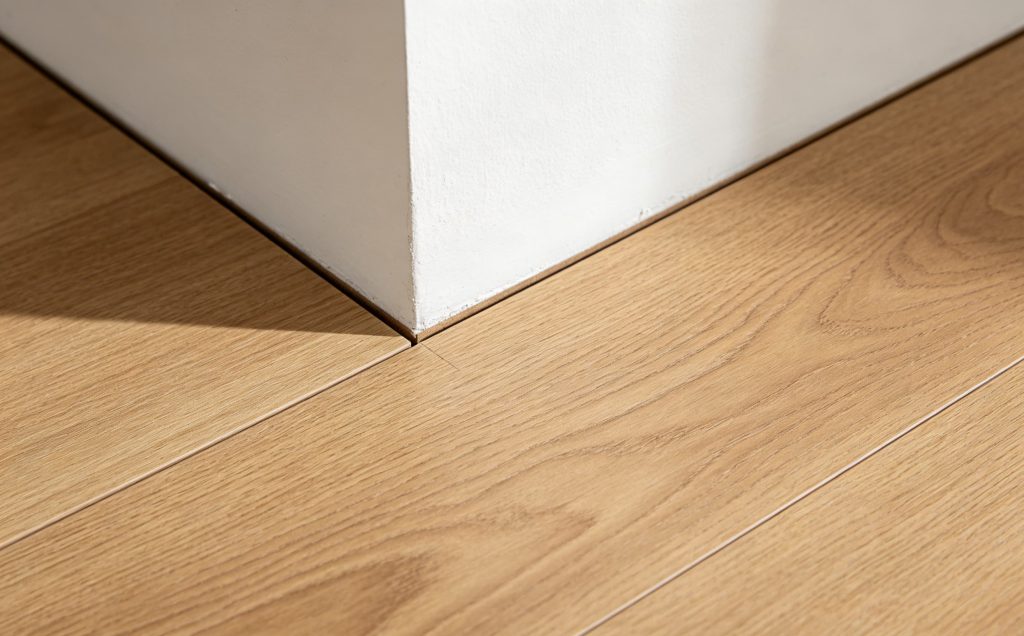
Table of Contents
What Is an Expansion Gap and Why Does SPC Flooring Need One?
An expansion gap is a small, intentional space left between the edge of your flooring and any fixed vertical surface — walls, cabinets, door frames, columns, and more. Its job is simple: give your floor room to breathe.
SPC (Stone Plastic Composite) flooring is made from a rigid core of limestone powder, PVC, and stabilizers. Compared to hardwood or even standard LVP, SPC is remarkably stable — it won’t swell dramatically with moisture changes. But “more stable” doesn’t mean “immune to movement.”
As the temperature increases or decreases indoors, the SPC flooring will experience expansion and contraction – although minimally. Being a floating floor (i.e., the planks click without being nailed or glued onto the floor), the movement of the whole floor is as one. With no space for expansion sideways, there is nowhere else for the movement to occur except upward.
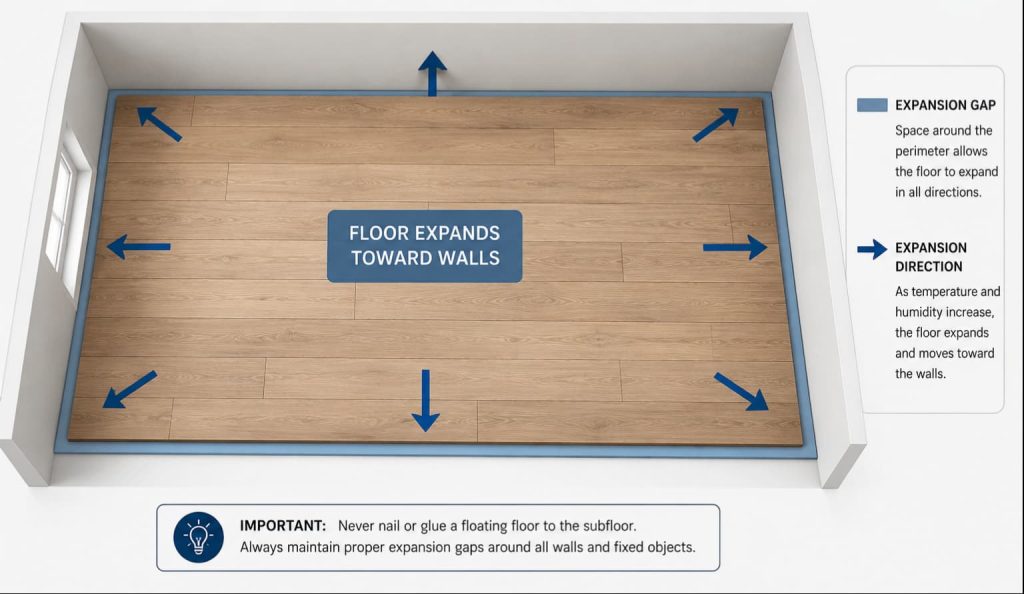
The result? Buckling, peaking, and damaged planks — all of which are expensive to fix and entirely preventable.
How Much Gap for SPC Flooring? (The Right Measurements)
This is the most common question installers face, and the answer depends on the size of the room and the specific installation scenario.
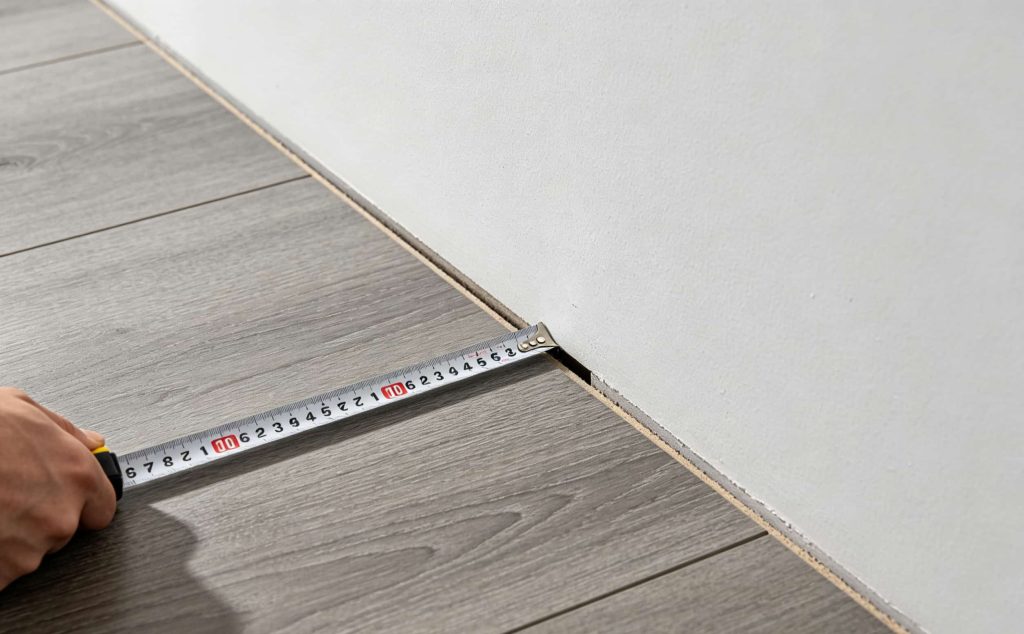
The general measurement required is ¼ inches (about 6mm) around each side. This is for the spacing of the floor from any permanent vertical surface in the area.
In bigger areas, however, this might not be enough. The fact that the floating floor expands and the accumulated expansion may be significant in wider spaces means that the spacing needs to be increased. For every 30 feet that the floor expands, there is a need to increase the spacing by another ⅛ inch. If the width of the floor exceeds 30 feet, then ⅜ inches (10mm) to even ½ inch spacing should be done.
Use the table below as a quick reference:
| Installation Scenario | Recommended Gap |
| Standard room (under 30 ft) | ¼ inch (6 mm) |
| Large room or open plan (over 30 ft) | ⅜ inch (10 mm) |
| Around doorframes and casings | ¼ – ½ inch |
| Around columns, islands, or fixed cabinetry | ¼ inch on all sides |
| Transition strip connections | ¼ inch minimum |
When in doubt, err on the side of slightly more gap. A larger gap is easy to hide with trim and molding. A gap that’s too small can cause real structural damage to your floor.
Where Do You Need to Leave an Expansion Gap?
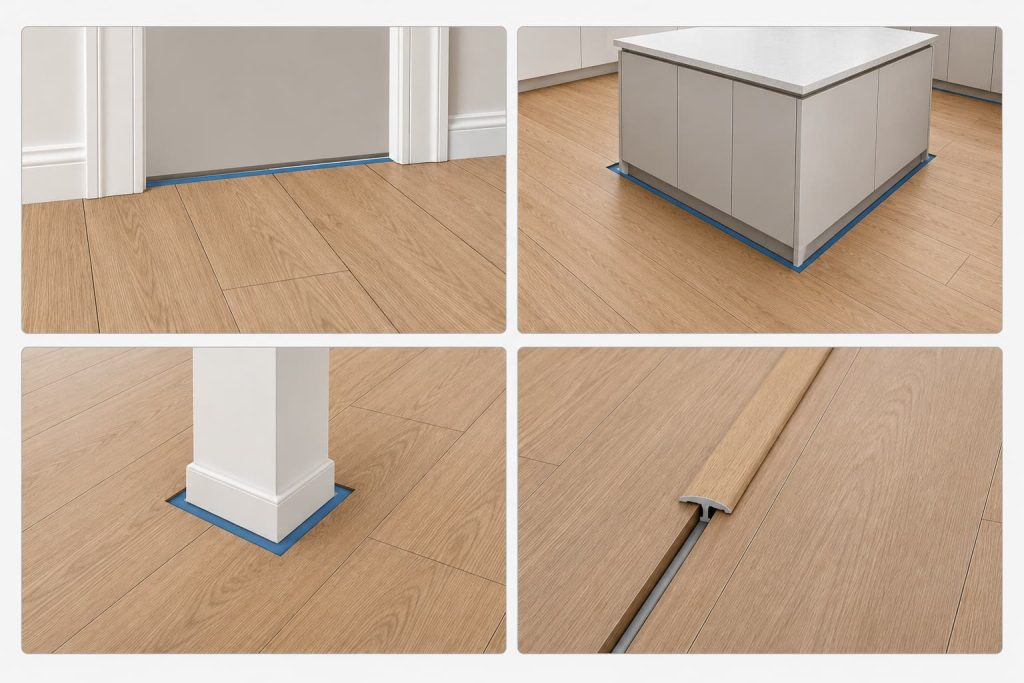
Most people remember to leave a gap along the main walls — but expansion gaps are required at every fixed vertical surface the floor runs up against. Here’s a complete checklist:
Along all perimeter walls. This is the most obvious location. Run your spacers consistently along every wall as you install.
At doorframes and door casings. This is the most commonly overlooked spot. Trim the bottom of door casings so the flooring slides underneath with the correct gap, rather than butting up hard against the casing wood.
Around kitchen islands and fixed cabinetry. If your floor runs under or around an island or built-in cabinet, leave a gap all the way around. These structures are anchored to the subfloor and don’t move with the floor.
Around support columns and pillars. Circle the entire column with a consistent gap.
At fireplace hearths and raised platforms. Any fixed raised surface counts.
At transition strips between rooms. The T-molding or reducer strip itself accommodates some movement, but the flooring still needs a gap on each side before reaching the strip.
What Happens If You Don’t Leave an Expansion Gap? (SPC Flooring Buckling)
A situation where flooring expands and raises due to lack of space for expansion is referred to as SPC flooring buckling. Since it cannot be allowed to move further and push against walls, the material ends up raising itself up by moving upwards.
Buckling of the floor is the most common problem in flooring installations made through do-it-yourself processes, and the culprit is usually the absence of expansion joints.
What buckling looks like
- Raised ridges appearing in the middle of the room (the floor is being pushed toward the center from all sides)
- Plank edges lifting or separating
- Clicking or creaking sounds underfoot
- Gaps opening up between planks in cooler conditions
Why it happens
No gap at all. The floor is installed wall-to-wall with no room to move. The first warm season causes expansion, the planks have no escape, and the floor lifts.
Gap that’s too small. A ⅛-inch gap might hold for a while, but in a large room or during an especially warm summer, even a small shortfall becomes a big problem.
Gap blocked by debris. Installation dust, adhesive residue, or small chunks of subfloor material fill the gap over time, eliminating the free space the floor needs.
Transition strips or baseboards nailed through the flooring. A baseboard nailed into the floor — rather than into the wall — pins the floor in place and prevents movement. The floor buckles against its own restraints.
Can you fix buckled SPC flooring?
Sometimes. If caught early and the planks haven’t cracked, you may be able to carefully remove the baseboard or transition strip, pull back the rows near the problem area, re-trim to create a proper gap, and re-install. If the planks have been stressed beyond recovery, replacement is the only option.
Prevention is dramatically easier — and cheaper — than repair.
Common Expansion Gap Mistakes to Avoid
Even experienced installers make these errors. Watch out for all of them:
Forgetting the gap at doorframes. It’s easy to focus on the main walls and forget that door casings are vertical surfaces too. Always undercut door casings before laying the floor.
Nailing baseboards through the floor. Baseboards should be nailed into the wall studs only — never into the flooring. The floor needs to float freely beneath the trim. If you nail through the floor, you’ve just anchored it in place.
Filling the gap with caulk or sealant. Some people look at the expansion gap and think it’s a draft problem or an aesthetic issue. Filling it with caulk eliminates the gap entirely and defeats its purpose. The floor will push against the hardened caulk just as it would against a wall.
Not adding a T-molding in long runs. In rooms or hallways longer than 40 feet, the cumulative expansion of the floor can exceed what the perimeter gaps alone can absorb. A T-molding transition strip in the middle of a long run gives the floor a relief point and prevents buckling from building up over distance.
Ignoring heating vents and floor registers. If you install flooring tight around a fixed floor register frame, you’ve created another anchor point. Leave a small gap and use an appropriate cover plate.
Does SPC Flooring Need Expansion Gaps More or Less Than Other Flooring?
SPC is actually one of the more forgiving flooring types when it comes to expansion — but it still needs a gap. Here’s a quick comparison:
SPC vs. solid hardwood. Solid hardwood is highly sensitive to moisture and temperature, and can expand dramatically across its width. Hardwood installations typically require ½ inch or more of expansion gap. SPC needs far less — ¼ inch is usually sufficient.
SPC vs. LVP (Luxury Vinyl Plank). Standard LVP is more flexible than SPC and can be more reactive to heat. SPC’s rigid core makes it more dimensionally stable, but both products require the same general approach: leave a perimeter gap and don’t anchor the floor.
SPC vs. ceramic tile. Tile is mortar-set and behaves completely differently — it doesn’t float, so expansion gaps aren’t required in the same way. However, grout joints serve a related function by accommodating minor movement.
The takeaway: SPC is more forgiving than hardwood or standard vinyl, but it is still a floating floor and still needs room to move. Don’t skip the gap just because SPC is marketed as “ultra-stable.”
How to Hide the Expansion Gap (Without Compromising Performance)
The expansion gap is a functional necessity, but nobody wants to see a ¼-inch trench running around the perimeter of their living room. Fortunately, hiding it is straightforward — as long as you don’t accidentally seal it in the process.
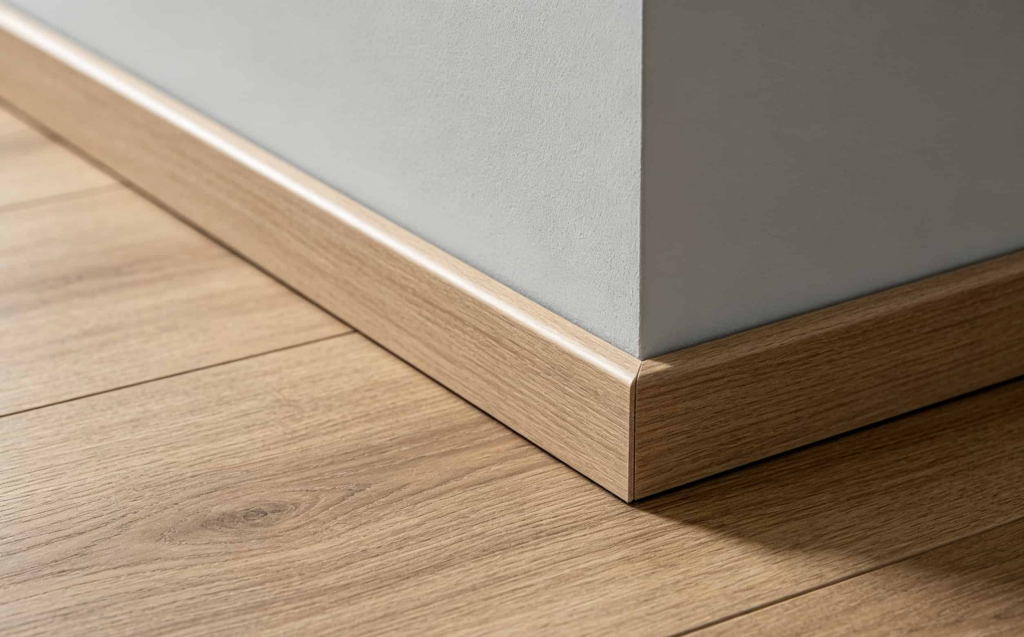
Baseboards and base molding. The most common solution. Install your baseboards after the floor is laid, nailing them into the wall (not the floor). The baseboard overhangs the gap and conceals it completely. Make sure the baseboard sits on top of the floor without pressing down on it — there should be a small amount of clearance.
Quarter round and shoe molding. If your baseboards don’t extend low enough to cover the gap, a thin strip of quarter round nailed to the baseboard (again, not the floor) fills in the space neatly.
T-molding and reducer strips. At doorways and transitions between rooms, T-molding covers the gap between two floor surfaces. Reducers are used where SPC meets a lower surface like tile or carpet.
What NOT to use. Never fill the expansion gap with caulk, grout, foam backer rod (when packed tightly), or any other rigid or semi-rigid filler. These materials will prevent the floor from moving and transfer expansion forces directly to your planks.
Frequently Asked Questions
Do I need an expansion gap for SPC flooring? Yes. Although SPC is more dimensionally stable than hardwood or standard LVP, it is still a floating floor that expands and contracts with temperature changes. An expansion gap is required around all fixed vertical surfaces.
What happens if the expansion gap is too small? If the gap is too small, the floor will run out of room to expand during warm weather. The planks will push against each other and against the walls, causing the floor to buckle, peak, or warp. In severe cases, individual planks can crack or separate.
Can I use caulk to fill the expansion gap? No. Caulk hardens and will prevent the floor from moving. It leads to buckling just like not having any gap at all. In case you wish to fill the gap aesthetically, opt for using baseboard trim or quarter round molding.
How do I fix SPC flooring that is buckling? First, identify what’s blocking the floor’s movement — usually it’s a gap that’s too small, blocked, or sealed. Remove the baseboards or transition strips around the affected area. If the planks haven’t cracked, carefully disassemble the rows near the buckling, trim back the edges to create proper gap clearance, and re-install. Replace any damaged planks.
Does SPC flooring need to acclimate before installation? Yes, though the acclimation period is shorter than for hardwood. Most manufacturers recommend leaving SPC boxes in the installation room for 24–48 hours before laying the floor. This allows the planks to reach the ambient temperature of the space, reducing post-installation expansion or contraction.
How wide should the expansion gap be in a hallway? A standard ¼-inch gap on each side wall is typically sufficient for a normal hallway width (3–4 feet). However, if the hallway is very long (over 40 feet), consider adding a T-molding break point partway along the run to manage cumulative expansion.
summary
The expansion gap is one of the smallest details in a flooring installation — and one of the most important. A ¼-inch gap around the perimeter of your room is all that stands between a beautiful, long-lasting floor and an expensive buckling repair job.
To recap the key rules:
- Leave a minimum ¼ inch (6mm) gap around all fixed vertical surfaces
- Increase to ⅜ inch or more in rooms larger than 30 feet
- Remember doorframes, columns, islands, and cabinets — not just walls
- Never nail baseboards through the floor
- Never fill the gap with caulk or sealant
- Use baseboard trim and quarter round to cover the gap without sealing it
Get the expansion gap right during installation, and your SPC floor will perform exactly as designed — stable, beautiful, and built to last.