

What Is SPC Flooring? Stone Powder + PVC Core Structure Explained
In recent years, SPC flooring (Stone Plastic Composite Flooring) has become increasingly popular as a flooring material for both home renovations, office renovations, and commercial projects such as hotels and shopping malls. It not only has a realistic wood grain or stone appearance, but also possesses advantages such as water resistance, wear resistance, easy installation, and easy maintenance. Therefore, it is widely used in various indoor spaces.
However, for many people, when they first encounter SPC flooring, they may have similar questions:
- What exactly is SPC flooring?
- How is it different from wood flooring, laminate flooring, and PVC flooring?
- Is SPC flooring really worth purchasing?
This article will provide you with a comprehensive understanding of SPC flooring and help you choose the floor product that suits you best.
Where Does the Name “SPC” Come From?
SPC stands for Stone Plastic Composite (sometimes written as Stone Polymer Composite). In Chinese markets it’s commonly called 石塑地板 or 石晶地板.
It has fundamental differences from the types of flooring we are familiar with:
- Compared with traditional LVT (elastic plastic flooring): The core of LVT is soft PVC, while the core of SPC is high-density rigid stone plastic.
- Compared with WPC (wood-plastic composite flooring): WPC uses wood powder + PVC, while SPC uses stone powder + PVC.
- Compared with ultra-durable flooring (Laminate): The core of ultra-durable flooring is high-density fiberboard (HDF), which is essentially wood and water-resistant; the core of SPC contains no wood fibers at all.
In a nutshell: SPC is a rigid composite flooring made with a high proportion of natural stone powder as the framework and PVC resin as the adhesive. Its essence lies not in the beautiful wood grain on the surface, but in the hard and dense stone plastic core in the middle.
Core Raw Materials: What Roles Do Stone Powder and PVC Play?
The reason it’s called “stone-plastic” is that its core is built from two main components:
1. Stone Powder
The proportion is usually between 60% and 75%, providing hardness, rigidity, compressive strength and dimensional stability. The proportion for some high-quality products may be even higher.
Why use stone powder instead of wood powder? Because stone powder does not absorb water, does not rot, and has very little thermal expansion and contraction. This directly determines that SPC will hardly expand or deform due to moisture.
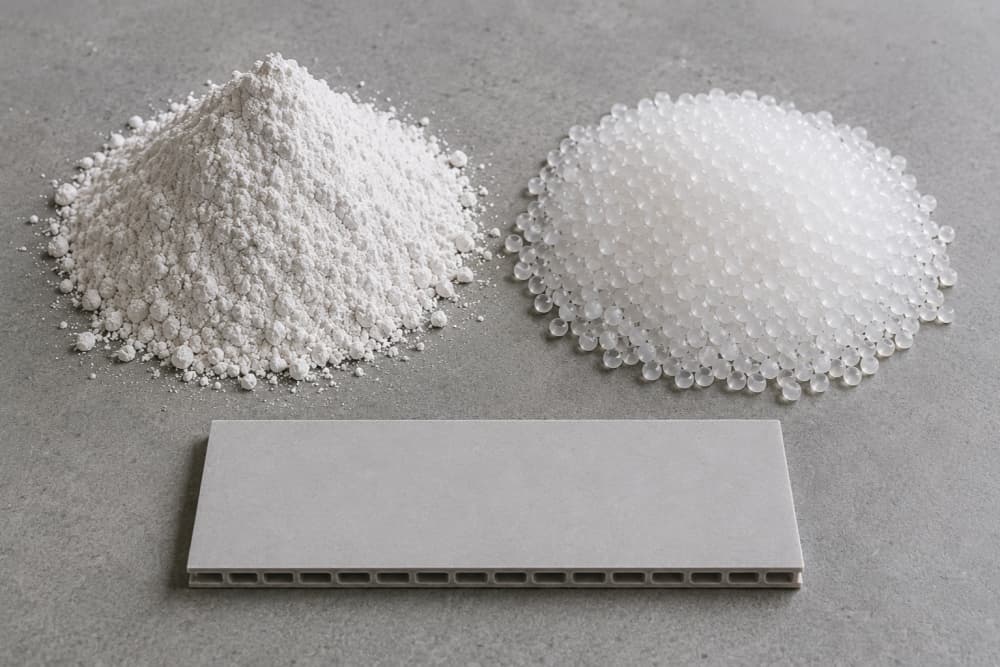
2. PVC Resin (Polyvinyl Chloride)
It accounts for approximately 20% – 30%. As a “glue” and source of toughness, it firmly bonds the stone powder particles together, while also endowing the material with waterproof properties and certain processing and molding capabilities.
In addition, a small amount of stabilizers, lubricants and other additives will also be added to enhance the weather resistance, prevent decomposition during high-temperature processing, and optimize the locking mechanism’s bite accuracy. It is precisely this “stone powder as the bone, PVC as the flesh” combination that enables SPC to have the hardness similar to that of stone while also possessing the waterproof and malleability of plastic.
The Complete Layer Structure of SPC Flooring
Although the SPC floor may appear to be just a thin sheet of material, in reality, it is usually composed of multiple functional layers. A complete SPC floor typically consists of five layers from top to bottom.
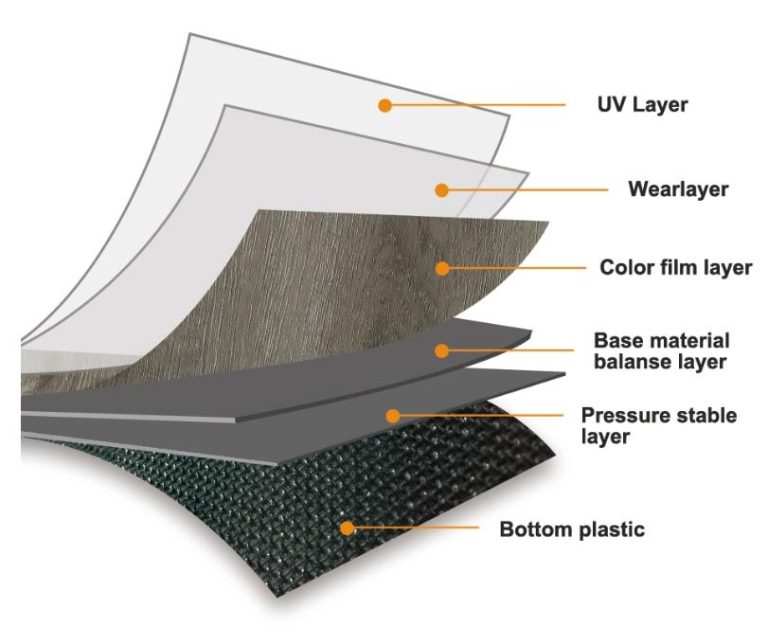
1. UV Coating (Outermost Layer)
A very thin layer of UV-curable coating. Its main functions are to resist scratches, stains, and UV rays, and to determine whether the surface has a glossy, matte, or super-matte texture. Although it is thin, it has a significant impact on the durability of the shoes in daily use. High-quality UV coatings can also reduce shoe prints, water stains, and oil residue, keeping the floor looking beautiful for a long time.
2. Wear Layer
The transparent PVC layer is one of the key indicators determining how long the floor can be used. Common thicknesses include 0.3mm (approximately 12 mils) and 0.5mm (approximately 20 mils). Commercial-grade products are usually thicker. The thicker the wear layer, the stronger its resistance to scratches and abrasion, and it can effectively extend the lifespan of the floor.
3. Printing Decorative Layer (Design Layer)
This layer determines the appearance effect of the SPC floor. Through high-precision printing, various wood grain, stone texture, and cement texture can be simulated. The current high-quality products can achieve synchronous matching of patterns (EIR), ensuring that the texture and surface texture are perfectly corresponding, providing a visual and tactile experience that is closer to the real material.
4. SPC Core Layer (The most crucial rigid substrate)
This is the “heart” of the entire floor. Its thickness is usually between 3.5–6mm. It is formed by high proportions of stone powder and PVC through a one-step hot extrusion process. It has a high density, almost no internal pores, and an extremely low water absorption rate (typically ≤0.5%). It is this layer that gives SPC 100% waterproofing, high compressive strength, dimensional stability, and strong locking performance.
5. Bottom / Noise Absorbing Pad (Backing)
Common materials include IXPE, EVA or cork. The main functions are to reduce vibration, provide sound insulation, slightly enhance the foot sensation, and to a certain extent, assist in moisture prevention. Many products already have pre-applied noise-absorbing pads, making installation easier; some need to be purchased separately.
In terms of total thickness, the mainstream products currently available on the market are mostly between 4 and 7 mm. It should be noted that: total thickness is not necessarily the thicker the better. The core density and the thickness of the wear-resistant layer are often more important than just the millimeter figure.
Further Reading: How to choose SPC flooring for your business
Manufacturing Process: Why Is the Structure So Stable?
The core layer of SPC is not assembled by multiple layers of glue bonding, but is formed in one go through high-temperature extrusion. The general process is as follows:
Precise mixing of raw materials → High-temperature extrusion molding → Cooling and shaping → Adhering and printing the layer and the wear-resistant layer → Surface embossing and UV treatment → Precise slotting to create locking mechanisms → Cutting into standard plates.
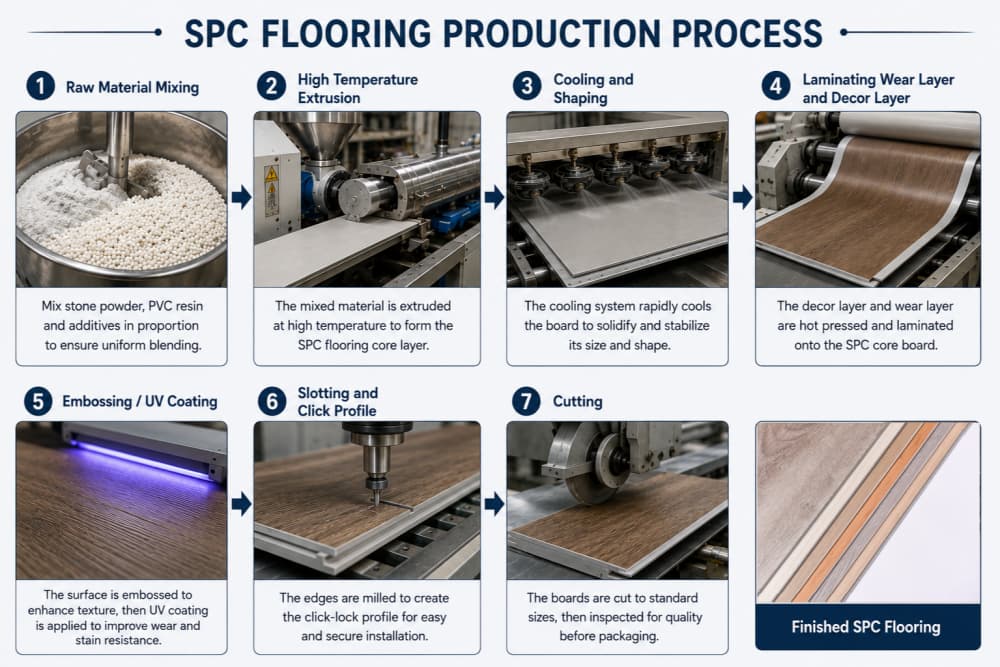
Because the core is a high-density board extruded in one go, there are almost no pores inside, and water molecules are difficult to penetrate. This is the fundamental reason why it can truly achieve “not expanding when soaked in water”. The locking part is achieved through high-precision slotting, making the boards tightly interlock with each other. During installation, no glue is needed, and it belongs to a suspended installation method.
How the Structure Determines Performance
If you connect the above structures together, you can clearly see where the performance comes from:
- 100% waterproof: The core is made of wood-free fibers and has almost no pores, so water cannot cause expansion or mold.
- High dimensional stability: The thermal expansion and contraction coefficient of the stone powder is extremely low, making it suitable for spaces with large temperature differences (such as south-facing areas, underfloor heating, balconies, and basements).
- Resistant to compression and indentation: High density and good rigidity make it significantly more resistant to heavy furniture, high-heeled shoes, and pet claws than traditional soft plastic flooring.
- Strong locking mechanism: The rigid core makes the clips fit more securely, and they are less likely to loosen over time.
- Harder to the touch: This is an inevitable result of the rigid structure. People who prefer a soft touch might prefer WPC or improve the situation by adding thick sound-absorbing pads.
A simple comparison with common flooring is as follows:
| Property | SPC | WPC | Laminate | Solid Hardwood |
| Core Material | Stone powder + PVC | Wood flour + PVC | High-density fiberboard | Natural wood |
| Water Resistance | 100% | 100% | Poor | Poor |
| Underfoot Feel | Firmer | Softer | Medium | Warm and resilient |
| Dimensional Stability | Excellent | Good | Medium | Lower |
| Indentation Resistance | Excellent | Good | Good | Fair |
How long can SPC flooring last?
The lifespan of high-quality SPC flooring typically ranges from 15 to 25 years. In commercial environments, it can generally be used for 10 to 20 years. If installation standards and daily maintenance are properly carried out, some high-end products can even last for over 20 years stably.
The main factors affecting lifespan include:
- Thickness of the wear-resistant layer
- Product quality
- Installation process
- Usage frequency
- Daily maintenance habits
Therefore, in addition to choosing high-quality products, correct usage and maintenance are equally important.
Conclusion
As people’s demands for the quality of living environment continue to rise, SPC flooring, with its advantages such as waterproofing, wear resistance, stable dimensions, easy installation and simple maintenance, has become an important choice for modern interior decoration.
Whether it is a family residence or a commercial space, as long as the appropriate thickness, wear-resistant layer and surface design are selected based on actual needs, and combined with proper installation and daily maintenance, SPC flooring can provide a long-term stable, beautiful and comfortable usage experience.
If you are looking for a flooring material that combines quality, beauty and durability, you may want to explore different specifications and series of SPC flooring products to find a more suitable solution for your next decoration project.