

Can SPC Flooring Be Installed Over Concrete? Everything You Need to Know
Many homeowners ask during renovations or remodeling: Can SPC flooring be laid directly on cement (concrete) floors? The answer is yes, and this is one of the most common and suitable application scenarios for SPC flooring. Whether it’s a bare cement floor, a concrete subfloor, or a basement, as long as the subfloor is properly prepared, SPC click-lock flooring can be quickly and stably installed.
Why is SPC Flooring Suitable For Concrete?
SPC (Stone Plastic Composite) flooring uses stone powder and PVC as its main raw materials, featuring a rigid core structure. It is more stable than traditional resilient PVC flooring, effectively bridging minor unevenness in concrete surfaces, and offers the following advantages:
- 100% Waterproof: Common moisture in concrete prevents flooring from warping or mold.
- Click-lock Floating Installation: No glue required, high installation efficiency, and can be disassembled later.
- Dimensional Stability: Less affected by temperature and humidity, suitable for ground floors and basements.
- Construction-Friendly: Can be directly laid over suitable concrete surfaces, saving on removal costs.
Therefore, SPC flooring is an ideal choice for concrete subfloors in residential, commercial, warehouse, and basement settings.
Core Requirements for Concrete Substrates
Successful installation hinges not on the flooring itself, but on the quality of the concrete substrates. Before installation, be sure to check the following:
1. Flatness
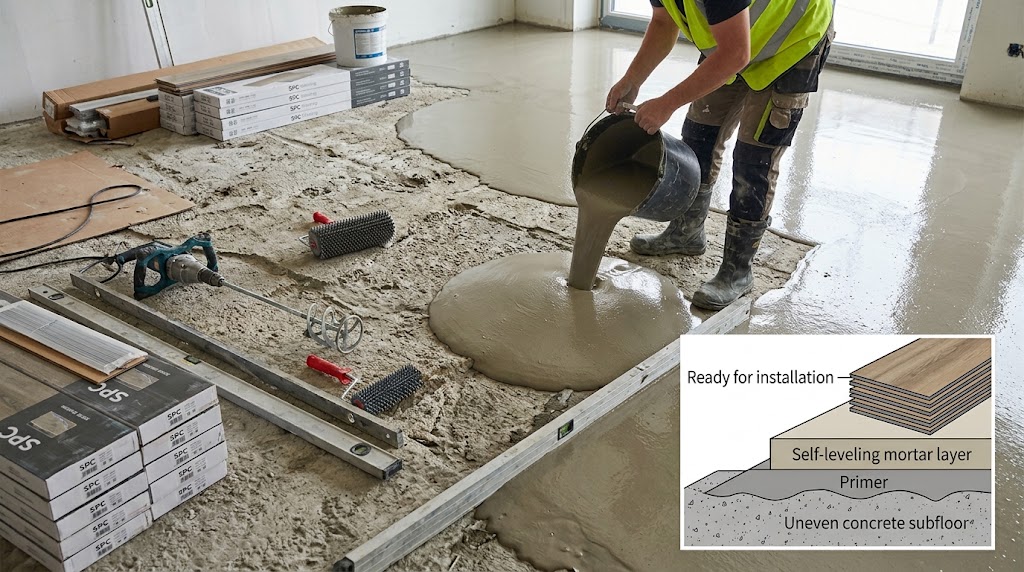
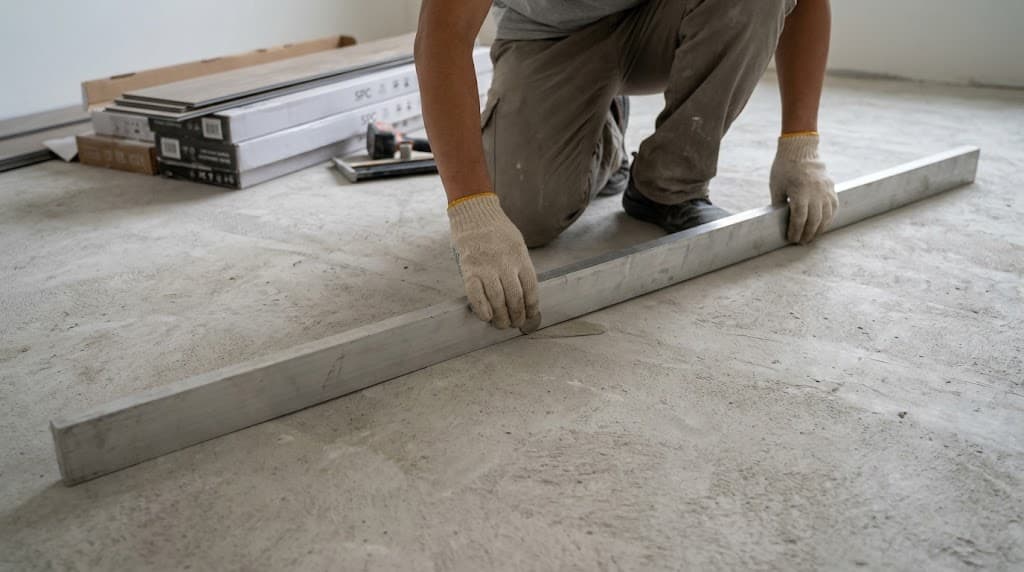
Generally, the error should be ≤2–3mm within a 2-meter range (international standard approximately 3/16 inch/10 foot). High points need grinding, and low points should be leveled with self-leveling mortar. Significantly uneven surfaces must be self-leveled; otherwise, the locking mechanism is prone to damage.
2. Dryness and Humidity
Concrete must be dry, with no visible water. New concrete requires adequate curing (typically 60–90 days or more). Humidity testing is recommended:
- Calcium chloride test (ASTM F1869): typically ≤3–8 lbs/1000 sq ft/24 hours;
- Relative humidity test (ASTM F2170): typically ≤85–90%.
Refer to the manufacturer’s instructions for specific details. Direct paving is not recommended on surfaces with a history of high humidity or hydrostatic pressure.
3. Strength and Stability
The floor should not produce sand, hollow areas, or cracks; the surface should be firm and dense.
4. Cleanliness
Free from dust, grease, old adhesives, paint, chemical residues, and other contaminants.
5. PH Value
Most requirements are around 7–9. Special Reminder: Basements or damp environments require extra attention to moisture-proofing.
Essential Preparations Before Installation
- Thorough Cleaning: Sweep, vacuum, and remove residue with a suitable cleaning agent if necessary.
- Leveling: Use self-leveling cement or leveling mortar and allow to dry completely and harden.
- Humidity Testing and Moisture Proofing: Most manufacturers recommend laying a 6-mil polyethylene vapor barrier on the concrete, overlapping and sealing the seams. Even if SPC includes IXPE or EVA sound-absorbing pads, a moisture barrier is still often recommended, especially for the subfloor.
- Flooring Adaptation Storage: Allow the flooring to stand in the installation environment for 24–48 hours, controlling the indoor temperature (recommended 15–28°C) and humidity.
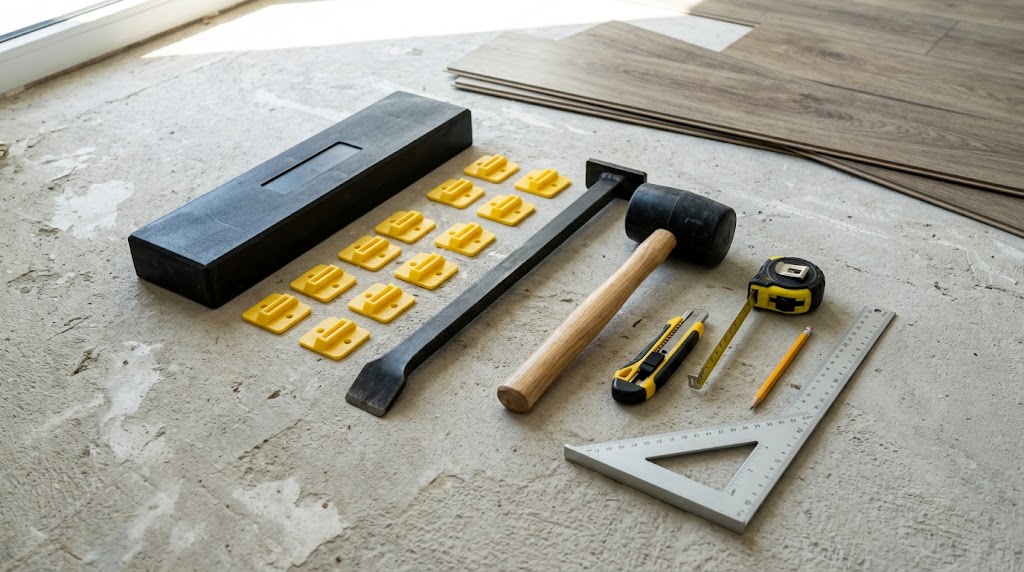
- Tools Preparation: Utility knife or electric saw, hammer block, hook, spacer blocks (for expansion joints), right-angle ruler, measuring tape, etc.
SPC Flooring Installation Methods
The underlayment (usually IXPE, EVA, or cork) of SPC flooring generally does not require adhesive. It primarily connects to the flooring using three methods: self-adhesive backing, double-sided tape, or direct floating installation.
1. Self-Adhesive Backing (Integrated Soundproofing Mat)
Many high-quality SPC floorings now have the underlayment bonded to the backing using high-temperature hot-pressing technology at the factory. Installation method: No additional steps are required; simply use the interlocking system during installation.
2. On-site Installation
If the moisture-proof or soundproofing mat rolls are purchased separately, they are typically secured during installation:
Alignment and Laying: First, lay the underlayment flat on the subfloor, ensuring the seams are tightly closed and not overlapping.
Tape Fixing: Use specialized waterproof adhesive tape (such as aluminum foil tape or masking tape) to seal the seams between the mats, preventing moisture from seeping through. The edges can be folded up about 5 cm against the wall; any excess can be trimmed with a utility knife.
3. Floating Installation (Glue-Free Process)
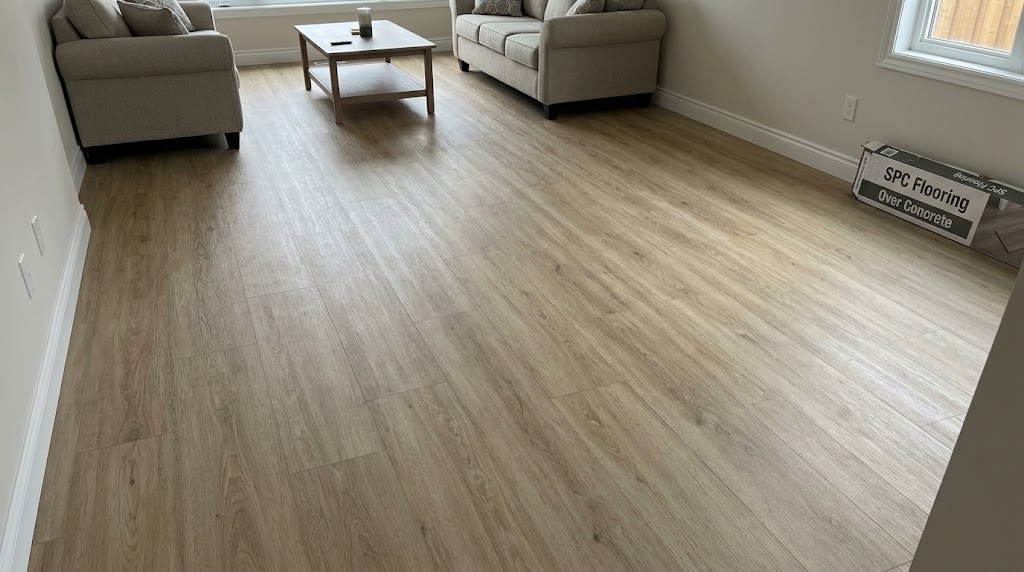
For ordinary click-lock SPC flooring, the “floating installation method” is often used during construction: the underlayment (such as PE film or foam pad) is laid directly on the leveled cement or tile floor. Flooring bonding: No glue is used between the underlayment and the floor, or between the underlayment and the flooring; it is fixed and flattened entirely by the weight of the SPC flooring itself and the interlocking force of the clips around the edges.
Summary
SPC flooring can be laid perfectly on concrete floors with excellent results. The key to success lies in: a flat, dry, and clean subfloor + proper moisture control + allowing expansion joints + strictly following the manufacturer’s installation instructions.
A lot of the time, the real reason for warping, squeaking, and later damage to the locking system is inadequate subfloor preparation, kind of. If the job is complex or it’s a big area, it’s usually better to hire professional installers and not improvise. Also, try to pick brands that really do explicitly support concrete installation, not just “works with” in a vague way, because that can make things a bit different.