

WPC Wall Panel Thickness Guide: Common Thicknesses and Their Applications
In the last ten years, there has been consistent growth in the WPC wall panel market globally due to increasing demand for robust, maintenance-free, and versatile building products. For B2B customers, such as wholesalers, distributors, construction companies, and developers, specifying WPC wall panels means making an informed decision about a product. In terms of all other specifications, thickness is the most crucial factor.
Selecting the wrong thickness might bring about serious consequences that might include non-compliance with the structure, extra expenses for fixing the problem, complaints from customers, and in the end, harm the reputation of your organization. Selecting the right thickness will allow you to optimize your expenses in terms of logistics, installation, and customer satisfaction.
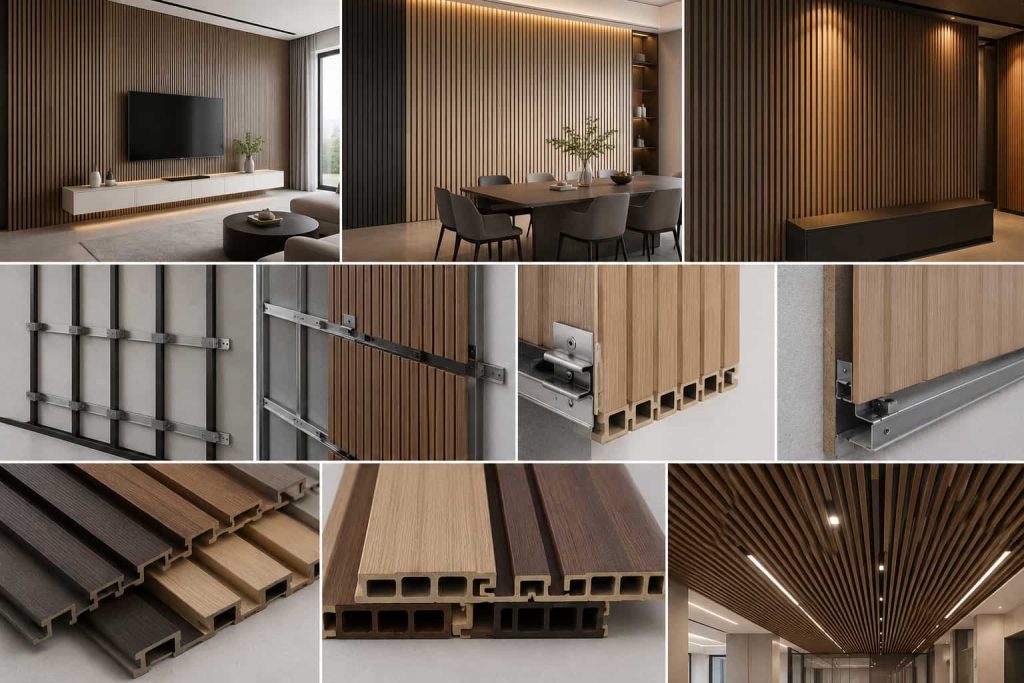
Table of Contents
Material Composition & How Thickness Is Formed
To understand why WPC panels behave differently depending on their thickness, an introduction to material science is necessary. WPC material is made through combining wood-based fibers (30%-60%) and thermoplastics such as HDPE, PVC or PP with other additives using high temperature and pressure during extrusion process.
Composition Breakdown
- Wood fibre (bamboo flour, wood powder): Provides natural texture, structural rigidity, and visual warmth
- Thermoplastic resin (HDPE / PVC / PP): Delivers waterproofing, corrosion resistance, and dimensional stability
- Functional additives: UV stabilisers, flame retardants, foaming agents, anti-aging compounds, and colourants
Solid vs. Hollow-Core Profiles
The panel thickness is related to its strength, but not only that; its internal structure is also important. Solid core panels, which are thicker, are heavier and more rigid than chambered panels. In B2B marketing, this is an important consideration especially for products that have to be specified according to their weight or load-bearing capacity.
Standard Thickness Range
Thickness specification for the industry standard of WPC wall panels ranges from 3 mm to 30 mm, but the most commercially viable range is 6 mm to 20 mm. The normal thicknesses that have been observed include 6 mm, 8 mm, 9 mm, 10 mm, 12 mm, 15 mm, 18 mm, and 20 mm.
Surface Finish Reminder
Panel thickness is independent of surface treatment. Co-extrusion capping, thermal-transfer woodgrain printing, hot-press texturing, and UV coating can be applied across a wide range of thicknesses. Always specify surface finish separately from structural thickness.
Mainstream Thickness Specifications — Detailed Analysis
The following four categories cover the commercially dominant thickness ranges, each with distinct performance envelopes and target applications.
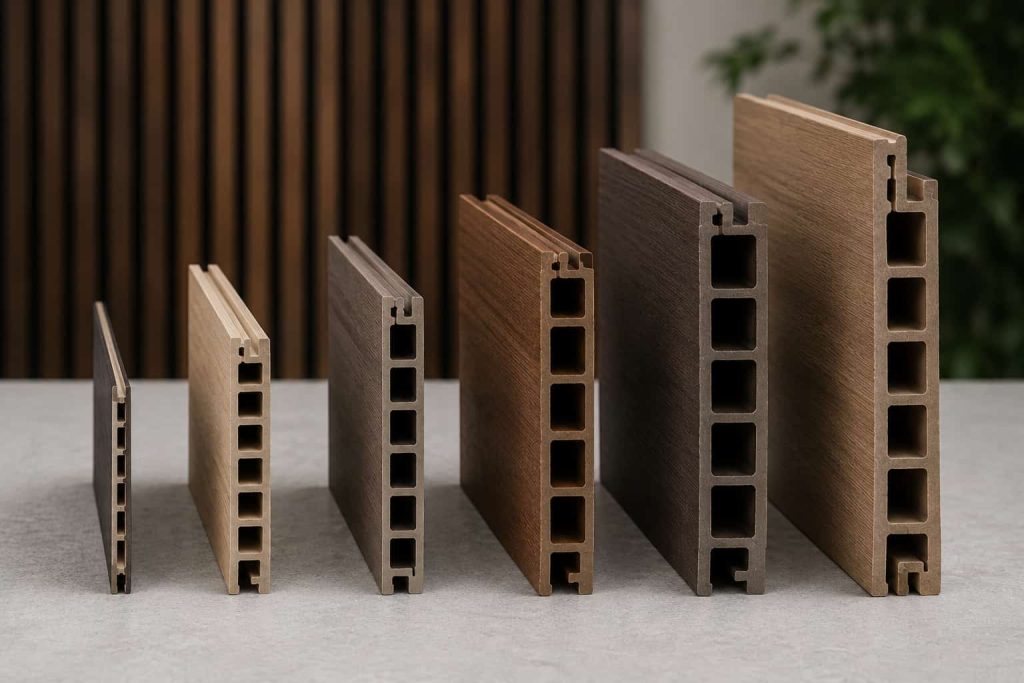
Thin Panels: 6 mm – 8 mm
| 6 mm – 8 mm | Lightweight Decorative Grade | |
| Key Highlights | Optimal for non-load-bearing interior applications where weight and installation speed are priorities. |
| Weight | Very light — minimal impact on building structure and logistics cost |
| Structural strength | Low to moderate — not recommended for impact-prone zones |
| Installation | Fast — adhesive + clip systems; no heavy subframe required |
| Cost efficiency | Highest — lowest material and freight cost per sqm |
| Typical applications | False ceilings, display booth walls, accent feature walls, exhibition partitions |
| B2B note | High-velocity SKU for hospitality fit-outs and residential renovation channels |
Medium Panels: 9 mm – 12 mm
| 9 mm – 12 mm | Commercial Interior Standard | |
| Key Highlights | The global volume leader — balancing structural performance, moisture resistance, and cost across the widest range of indoor applications. |
| Weight | Moderate — manageable for standard installation crews |
| Moisture resistance | Excellent — waterproof, termite-proof, swelling-resistant; suitable for wet areas |
| Sound insulation | Improved over thin grades — effective in partitioned commercial spaces |
| Fire compliance | B1-class flame retardant achievable at this thickness range |
| Typical applications | Hotel rooms, office interiors, retail environments, kitchen & bathroom cladding, residential accent walls |
| B2B note | Dominates 60%+ of global B2B order volume; prioritise this range for core inventory |
Heavy-Duty Panels: 15 mm – 20 mm
| 15 mm – 20 mm | High-Performance Exterior & Commercial Grade | |
| Key Highlights | Engineered for exterior cladding, high-traffic public spaces, and environments with demanding structural and climatic requirements. |
| Structural strength | High — suitable for facade cladding with metal or reinforced subframe systems |
| Impact resistance | Excellent — withstands mechanical contact in public circulation areas |
| UV & weather resistance | Superior — maintains dimensional stability under prolonged outdoor exposure |
| Thermal performance | Enhanced insulation contribution in wall assemblies |
| Typical applications | Exterior building facades, hotel lobbies, shopping malls, airports, public architecture |
| B2B note | Higher unit price and freight cost; target premium project channels and specify co-extrusion cap for outdoor use |
Industrial Grade: 20 mm and Above
| 20 mm + | Structural & Industrial Grade | |
| Key Highlights | Reserved for applications requiring load-bearing performance, heavy mechanical impact resistance, or extreme weather durability. |
| Load capacity | High — screw-holding strength suitable for wall-mounted fixtures and shelving |
| Durability | Maximum service life expectancy in outdoor and semi-industrial settings |
| Installation complexity | High — requires engineered subframe; professional installation essential |
| Freight consideration | Heaviest tier — freight cost a significant factor in landed cost calculation |
| Typical applications | Outdoor seating structures, balcony enclosures, industrial wall linings, heavy-duty storage units |
| B2B note | Niche volume but high unit value; suitable for project-based selling, not open-stock distribution |
Thickness to Application Selection Matrix
The following matrix consolidates the key decisions for B2B professionals specifying or sourcing WPC wall panels. Use this as a first-pass reference when evaluating project briefs or advising distributor clients.
| Application Scenario | Recommended Thickness | Key Performance Requirements | Typical Projects |
| Indoor Decorative Feature Wall | 6 – 9 mm | Lightweight, aesthetics, easy installation | Residences, showrooms, exhibition booths |
| Kitchen & Bathroom Wet Areas | 10 – 12 mm | Waterproof, mold-resistant, dimensional stability | Homes, apartments, hotel bathrooms |
| Hotel & Commercial Interiors | 12 – 15 mm | Wear resistance, fire rating, visual impact | Hotel lobbies, offices, retail stores |
| Exterior Wall Cladding / Facade | 15 – 20 mm | UV resistance, weatherproofing, structural strength | Commercial buildings, villas, public architecture |
| Industrial / Heavy-Duty Environments | 20 mm + | Load-bearing, impact resistance, long service life | Warehouses, outdoor furniture, balcony enclosures |
Procurement Tip
When a client cannot clearly define their application scenario, ask three qualifying questions: (1) Indoor or outdoor? (2) Residential or commercial? (3) Wet area or dry? These three answers alone will narrow the appropriate thickness range to one or two options.
How Thickness Affects B2B Cost Structure
Thickness is a key cost factor influencing the whole supply chain. Mastering its impact helps B2B buyers better control pricing, profits and business consulting.
Material Costs
Thicker WPC boards need more raw materials per square meter. Every extra millimeter raises production costs, while high-end surface finishes further widen price gaps between different thicknesses.
Logistics & Shipping Costs
WPC export freight is mainly calculated by weight. Thicker boards reduce loading quantity per container, lifting overall landed costs. Optimizing thickness is the top way to cut shipping expenses in high-freight areas.
Installation Labor Costs
Heavier thick boards demand stronger auxiliary frames, more accessories and longer working hours. Excluding material expenses, their full installation cost is 40%-70% higher than thin boards of the same coverage area.
B2B Cost Optimization Rule
Distributors and builders should suggest the most suitable minimum thickness for actual use instead of over-specifying. Excessive thickness causes budget waste; insufficient thickness leads to after-sales troubles and brand risks. Professional thickness guidance becomes a core competitive edge in B2B trades.
Cost Model Example
A 500 sqm hotel corridor project specified at 15 mm instead of the structurally sufficient 12 mm adds approximately 25% to material cost and 15% to freight cost, with no performance benefit. For a distributor, recommending the right spec protects the client relationship and demonstrates technical credibility.
Regional Market Preferences — Global Thickness Intelligence

WPC wall panel specifications are not universal. Market preferences diverge significantly across regions due to differences in construction standards, aesthetic traditions, climate conditions, and regulatory environments. B2B buyers serving multiple markets must calibrate their product lines accordingly.
| Region | Preferred Width | Preferred Thickness | Key Procurement Focus |
| North America (US/CA) | 200 – 300 mm | Thicker grades | Durability, commercial & residential upgrades |
| Europe | 150 mm slim | Moderate (10–15 mm) | Precision edge profiles, minimalist aesthetics |
| Middle East | 200 – 300 mm | Long continuous panels (3.6 m+) | Luxury villas, mosques, high-end hospitality |
| Southeast Asia | 150 – 200 mm | 10 – 15 mm solid | Moisture & mold resistance, tropical climate durability |
| Australia / NZ | 150 – 200 mm | 12 – 20 mm | Outdoor cladding, bushfire-rated options |
| South Asia (India) | 150 – 200 mm | 8 – 15 mm | Cost efficiency, furniture & modular interiors |
B2B Procurement Checklist — 8 Decision Points
Before finalising any WPC wall panel order, B2B buyers and project specifiers should systematically work through the following eight decision points. This checklist is designed for use in both project-based procurement and open-stock distribution planning.
| # | Checklist Item | Guidance Notes |
| 01 | End-use environment confirmed? | Indoor / outdoor, residential / commercial, dry / wet area |
| 02 | Local building codes & fire ratings met? | CE, ASTM, ISO, B1 flame-retardant class or local equivalents |
| 03 | Structural subframe requirement identified? | Thin panels (< 9 mm): standard; thick panels (> 15 mm): reinforced metal frame |
| 04 | Regional size preference confirmed? | Width, length, thickness preferences vary by market (see Section VI) |
| 05 | Surface finish & texture specified? | Co-extrusion cap, thermal-transfer woodgrain, solid colour, 3D fluted |
| 06 | OEM / custom capability verified? | MOQ, lead time, tooling cost for non-standard thicknesses or sizes |
| 07 | Physical samples tested? | Verify thickness tolerance, colour accuracy, and bending strength before bulk order |
| 08 | Total landed cost calculated? | Material + freight (weight sensitive) + installation labour + accessories |
Conclusion
Thickness selection in WPC wall panel procurement is far more than a technical footnote — it is a strategic decision with direct consequences for project compliance, cost efficiency, installation performance, and long-term client satisfaction.
The framework presented in this guide — spanning material science, application scenarios, cost structure analysis, and regional market intelligence — provides B2B professionals with the tools to move beyond guesswork and into systematic specification. The best performers as importers, distributors, and contractors of WPC around the world possess certain traits in common: They ensure that the thickness is appropriate for the job; they guide customers technically; and they have suppliers who can produce the entire specification range.
Three Strategic Priorities for B2B Success
- Build a thickness-differentiated product portfolio: Ensure your catalogue covers the 6–20 mm range with market-specific hero SKUs, rather than defaulting to a single standard thickness
- Develop specification capability: Invest in your team’s ability to advise on thickness selection — this is a competitive differentiator that commands premium pricing and builds long-term client loyalty
- Partner with certified, full-range manufacturers: Work with factories that offer OEM customisation, verified third-party certification, and consistent quality control across all thickness grades