

How to Renovate Hotel Rooms Without Closing the Entire Property
Renovating an occupied hotel sounds contradictory — but it’s the smarter financial decision for most properties. A 150-room hotel at $120 ADR loses over $540,000 in revenue for every 30 days of full closure. Rolling renovation — renovating a small batch of rooms at a time while the rest stay operational — keeps that revenue on the books.
The catch: rolling renovation only works if your materials support it. Traditional tile, wet plaster, and solvent paints require 48–72 hours of curing time and generate noise, dust, and chemical odors that make neighboring rooms unpleasant or unoccupiable. They were built for empty buildings.
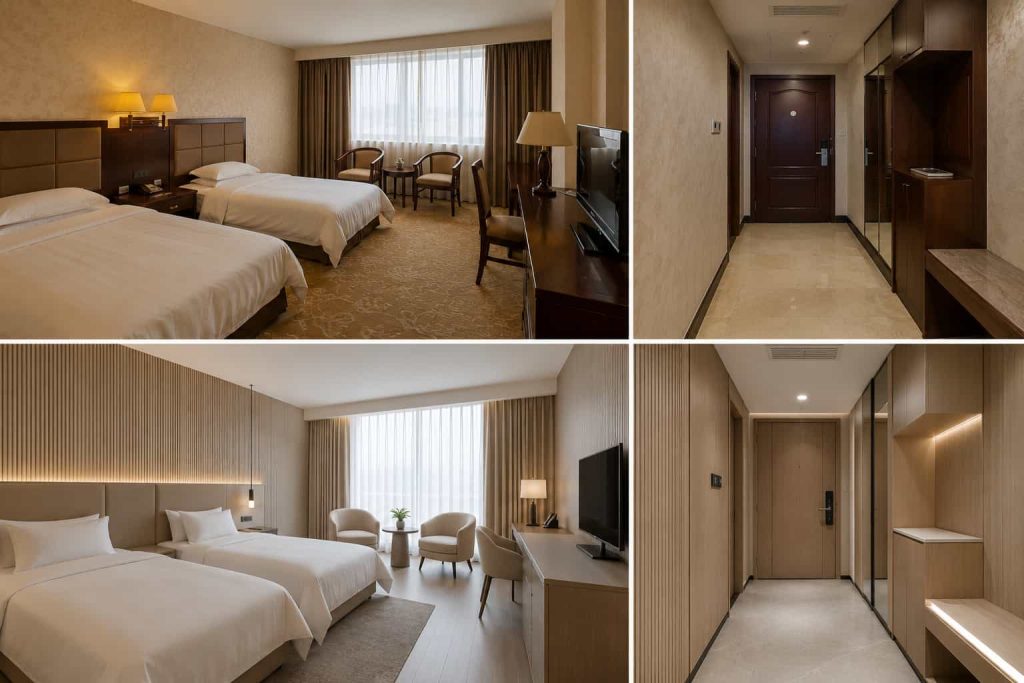
SPC Wall Panels, WPC Wall Panels, and SPC Flooring were built for exactly this scenario.
Table of Contents
The Core Challenge: Speed and Guest Impact
The two constraints that define every rolling renovation are timeline compression and guest disruption.
A room in a rolling renovation needs to go offline at checkout (11 AM) and return to inventory by the following morning. That’s a roughly 8-hour productive window. Ceramic tile installation alone takes 3–5 days per room — completely incompatible with this model.
Noise is equally critical. Traditional wet trades involve grinding, hammering, and adhesive application that exceeds what most brands allow within two rooms of occupied guestrooms. Even after the tools stop, adhesive and grout fumes can linger for 12–24 hours.
The solution is eliminating wet trades entirely.
SPC Wall Panels: Speed Without Compromise
SPC (Stone Plastic Composite) Wall Panels install via a click-lock dry-hanging system — no adhesive, no grout, no curing time. A two-person crew completes a standard 30 m² guestroom in 4–6 hours. The room is occupiable immediately after installation.
Key advantages for hotel use:
- Zero VOC emissions — no off-gassing waiting period
- 100% waterproof — suitable for bathrooms, wet areas, and sleeping zones in a single product
- Installs over existing surfaces — no demolition of old tile or drywall required
- 15–25 year commercial lifespan — no grout lines to re-seal or replace
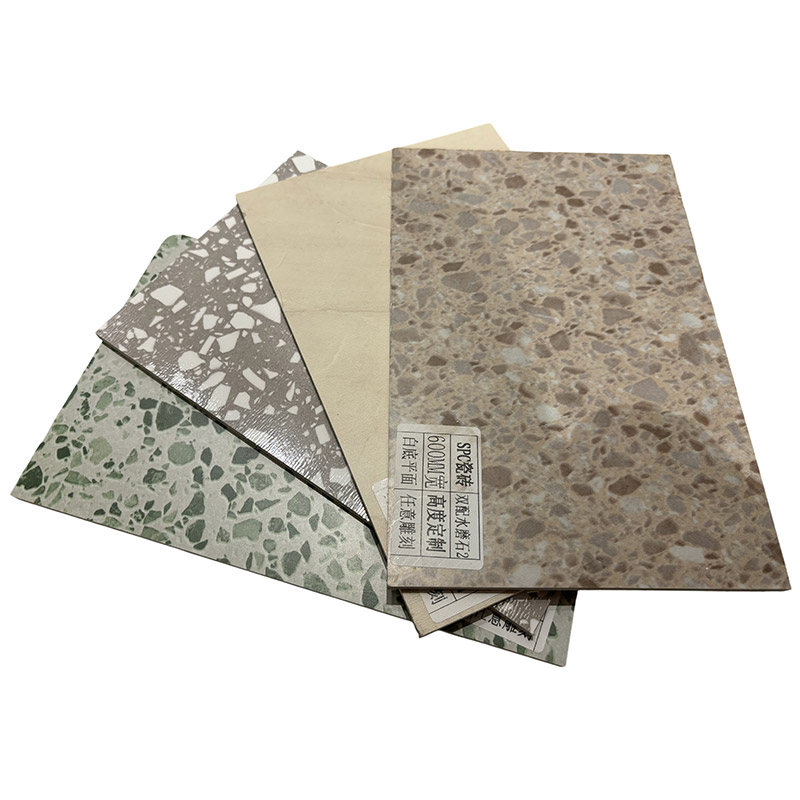
- Design range — marble, concrete, timber, and metal finishes at a fraction of natural material cost
WPC Wall Panels: The Premium Acoustic Choice
WPC (Wood Plastic Composite) Wall Panels share the dry-installation principle but use a wood-fiber composite core that absorbs sound rather than reflecting it — a meaningful advantage in hotel environments where noise between guestrooms drives negative reviews.
WPC panels are the preferred specification for:
- Boutique, resort, and wellness properties where tactile warmth and natural textures align with brand identity
- Party walls between adjacent guestrooms, where fiber absorption reduces airborne noise transmission by 3–5 dB vs. SPC
- Sustainability-positioned hotels — many WPC products carry recycled content that supports LEED and Green Key certification
The practical recommendation for most guestrooms is a hybrid specification: SPC panels in the bathroom (full waterproofing required), WPC panels in the sleeping area (acoustic and aesthetic priority).
| SPC Wall Panels | WPC Wall Panels | |
| Waterproof | 100% | Water-resistant |
| Best zone | Bathroom, wet areas | Bedroom, feature walls |
| Acoustic performance | Good | Better |
| Best for | All hotel types | Boutique, resort, luxury |
SPC Flooring: Renovate Over the Existing Floor
SPC Flooring’s single biggest advantage in a rolling renovation context is that it installs directly over most existing substrates — existing vinyl, tile, hardwood, and even low-pile carpet — eliminating demolition entirely.
Traditional flooring renovation requires 4–6 hours just for rip-out and disposal before new material can go down. SPC flooring skips that phase completely. A 28 m² guestroom floor installs in 2–3 hours.
Combined with SPC/WPC wall panels, a complete room transformation — floor and all walls — fits within a single 8-hour shift:
| Time | Activity |
| 11:30 AM | Wall treatments removed |
| 12:30 PM | SPC Flooring installed (click-lock, over existing substrate) |
| 2:30 PM | SPC/WPC Wall Panels installed |
| 6:30 PM | Skirting, trim, furniture reinstalled |
| 8:00 PM | Room returned to front office inventory |
Additional SPC flooring advantages for hotel use:
- 100% waterproof — runs continuously from bedroom through bathroom, no threshold strip needed
- AC4 wear layer for guestrooms; AC5 for corridors and high-traffic areas
- Pre-attached acoustic underlayment versions deliver 8–12 dB IIC improvement, reducing impact noise complaints
The Financial Case
The ROI calculation for SPC/WPC systems is straightforward once lost revenue is included.
At $150 ADR and 80% occupancy, each offline room-day costs $120 in lost revenue. Traditional tile keeps a room offline for 4 days; SPC panels reduce that to 1 day — recovering $360 per room. For a 100-room renovation, that’s $36,000 in recovered revenue that more than offsets any material premium.
| Ceramic Tile | SPC Wall Panels | |
| Material + labor + demo | $1,500–$2,500 | $800–$1,400 |
| Lost revenue (at $120/day) | $360–$600 | $120 |
| True total cost | $1,860–$3,100 | $920–$1,520 |
Long-term, SPC and WPC panels eliminate grout maintenance (re-sealing every 2–3 years, replacement every 5–7), reduce cracking and delamination repairs, and allow single-panel replacement after damage — no tile matching required.
Conclusion
Rolling renovation with SPC Wall Panels, WPC Wall Panels, and SPC Flooring keeps your property earning revenue throughout the upgrade process. The materials aren’t a trade-off — they outperform traditional finishes on installation speed, durability, maintenance cost, and acoustic performance.
Recommended specification for a full guestroom renovation:
- Bathroom walls → SPC Wall Panels
- Bedroom / feature walls → WPC Wall Panels
- All floors → SPC Flooring with acoustic underlayment (AC5 corridors, AC4 guestrooms)
Ready to get started? Request samples and a project consultation to see how fast your property can be transformed — without closing a single unnecessary room.